Get Full Government Meeting Transcripts, Videos, & Alerts Forever!
Get email alerts on the Government Ethics topic
No spam. Unsubscribe anytime.
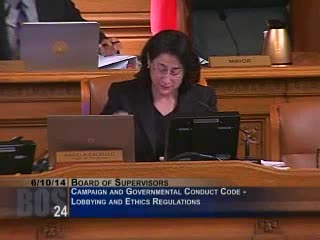
Board adopts lobbying and ethics reform ordinance on first reading; expands definitions and disclosure rules
Summary
The Board of Supervisors on June 10 approved, on first reading, a package of lobbying and ethics reforms that broadens the definition of lobbyist, narrows an attorney exemption, creates developer disclosure requirements and adds reporting for permit expediters above a $1 million permit value threshold.
The San Francisco Board of Supervisors on June 10 passed, on first reading, a package of amendments to the city's campaign and governmental conduct code that supervisors said will expand public disclosure and oversight of lobbying, permit expediters and developer donations to nonprofits.
President Chu (chairing the session) presented the ordinance as a transparency package that "will increase public confidence in the everyday workings of our local government," and cited the need to broaden who is considered a lobbyist and to require additional training and disclosures.
Major elements - Lobbyist definitions: The ordinance expands the definition of "lobbyist," distinguishing between in-house and contract lobbyists. In-house employees would be covered if they make more than five contacts in a calendar month; contract lobbyists would qualify if they are paid for lobbying and make one or more contacts in a calendar month. - Attorney exemption narrowed: The ordinance eliminates the broad "attorney exemption" but includes language clarifying it is not intended to regulate the practice of law. - Nonprofit and developer disclosures: The package creates a nonprofit exemption for most 501(c)(3) groups and smaller 501(c)(4)s but also adds a developer disclosure requirement: developers would have to disclose donations of $5,000 or more to nonprofits that contact the city on a project's behalf. - Permit-expediter reporting: The ordinance brings permit expediters under additional disclosure rules but, after committee negotiations, sets a permit-value threshold of $1,000,000 so that lower-value permits are excluded. - Enforcement and transparency: Sponsors added joint-and-several liability for employers for lobbyist conduct, expanded training and recordkeeping, and made unreported contacts a reportable violation rather than only late filings. The ordinance also requires public reporting of officials who fail to file Form 700 disclosures and publication of a contributors' guide.
Sponsor remarks "We're simply saying that it's important for the public to know when they occur," President Chu said of the effort to "shine a brighter light" on influence. He cited the city attorney's enforcement work and noted changes made after committee hearings to address nonprofit and small-business concerns.
Floor action and next steps Supervisor Chu moved the package of amendments; a second was recorded on the floor and the Board took the amendments "without objection." The ordinance was adopted on first reading as amended; sponsors included an effective date of Jan. 1, 2015 in their amendment package. The measure will return for subsequent readings required under the city's legislative process.
Ending Supporters characterized the package as a balance between transparency and not unduly burdening small organizations. The ordinance expands who must disclose lobbying activity, creates targeted developer and permit-expediter disclosures, and moves enforcement and training responsibilities forward for the city.