Get Full Government Meeting Transcripts, Videos, & Alerts Forever!
Get email alerts on the Housing Evictions topic
No spam. Unsubscribe anytime.
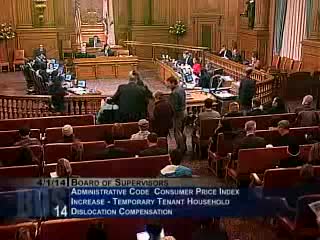
Debate over higher Ellis Act relocation payments continued after supervisors split over protections for small landlords
Summary
Supervisors continued debate on an ordinance that would increase relocation payments landlords must make after Ellis Act evictions and debated amendments to protect long‑term small property owners; the board delayed final action to allow more time for amendment work and consultation.
The Board of Supervisors continued debate on an ordinance that would increase relocation payments landlords must make when using the Ellis Act to withdraw residential units from the rental market. The item was not finalized on Tuesday; supervisors agreed to continue the matter for further consideration.
Why it matters: The measure is aimed at increasing financial assistance to tenants displaced by Ellis Act evictions. Supporters say higher payments are required to allow long‑term tenants to remain in or reasonably replace housing in the city; opponents and several supervisors warned that increases could harm elderly small landlords who rely on their property sale for retirement.
Supervisor David Campos, the ordinance author, said the city faces an affordability crisis and that current relocation payments—$5,265 per tenant and a $15,795 per‑unit cap—are out of step with market rents. “The ordinance that we are voting on today is an ordinance that will require landlords who evict using the Ellis Act to pay the difference between the tenant’s rental rate prior to eviction and what would have been the market rate for that very unit during a 2 year period,” Campos said.
Several amendments were proposed. Supervisor Breed offered an amendment to exempt small senior property owners who meet tightly drawn criteria (owners 55 or older, at least 20 years of ownership, building of four units or fewer and the owner's primary residence) from the higher payment requirement; Supervisor Yee sought to add more specific factors for rent‑board consideration in hardship waiver hearings; Supervisor Wiener proposed narrower hardship application rules for landlords to exclude retirement accounts and non‑liquid assets except in specified small‑owner circumstances.
Opponents of the blanket increase — including Supervisor Bridal, who described vulnerable elderly homeowners in her district — argued that without very narrow hardship exceptions the new requirements could threaten small, long‑term owners' retirement security and unintentionally encourage speculators to use Ellis Act evictions.
Board action: Because supervisors indicated they wanted more time to reconcile several competing amendments, a motion to continue consideration to later in the meeting was made and accepted; at the meeting’s end supervisors again agreed to continue the item to a date certain in order to finalize language and allow more discussion and consultation.
Next steps: The ordinance remains under active debate. Staff said the board would take up specific amendment votes when it reconvenes the item; the recorder noted the item would be continued to give time to sort overlapping amendments and ensure protections for truly vulnerable owners while increasing tenant assistance.