Get Full Government Meeting Transcripts, Videos, & Alerts Forever!
Get email alerts on the Housing Accessory Units topic
No spam. Unsubscribe anytime.
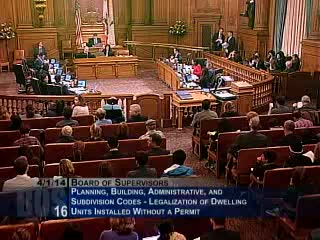
Supervisors pass first reading for voluntary legalization of in‑law units; ordinance moves forward amid neighborhood debate
Summary
The Board passed, on first reading, legislation to allow owners to legalize existing unpermitted accessory dwelling units voluntarily, with tenant protections and monitoring requirements; the measure passed 8–2 after amendments and promises of monitoring.
The Board of Supervisors passed an ordinance on first reading to create a voluntary program allowing homeowners to legalize existing in‑law units citywide while protecting tenants and limiting certain conversions. The vote on the ordinance, as amended, was 8–2.
Why it matters: City officials said the measure aims to bring tens of thousands of unpermitted units into legal housing stock, protect vulnerable tenants, and preserve affordable units by establishing a low‑cost legalization pathway and a monitoring requirement. Opponents said the change could encourage evictions, allow speculative conversions, and harm neighborhood character in some zoning districts.
Supervisor David Chiu, who authored the ordinance, said the city faces an affordability crisis and that an estimated 30,000–40,000 unpermitted “in‑law” units already exist. “We want to allow an owner to legalize one existing in‑law unit without additional permits on a voluntary basis,” Chiu told the board, adding the proposal would waive certain planning rules that do not affect life‑safety requirements.
The ordinance includes tenant protections that Planning staff and the author emphasized: legalized units would preserve rent‑control status; major capital improvements would not be allowed to be passed through to tenants without review; legalized units could not be subdivided into condos; projects involving construction would require relocation and reimbursement; and units would be barred from legalization if there had been recent no‑fault evictions in the unit's building.
Amendments and debate: Supervisor Yee proposed two amendments — one to prohibit legalization in RH1D single‑family zoning districts, and a second to pilot the program until 50 units had been legalized and then require a report. The board took the amendments separately; the RH1D exclusion failed on a roll call, and supervisors debated the pilot threshold and a package of deletions of language carried over from a 1984 ordinance. Several supervisors asked for robust monitoring and reporting; Planning staff confirmed the ordinance already requires six‑month reports for the first three years.
Vote and next steps: The Board adopted the ordinance on first reading, 8–2, with Supervisor Tang and Supervisor Yee voting no. The ordinance will return for a second reading; Planning and the Department of Building Inspection will track permits and provide required six‑month reports to the Board for the first three years, and the legislation includes a hearing requirement at one and two years to assess impacts and possible changes.
Context: Supporters said legalization would protect low‑income, long‑term tenants who live in unpermitted units and help homeowners make modest income, while opponents said voluntary legalization risks doing too little and could advantage owners who evict in order to qualify for legalization. The ordinance also explicitly preserves neighborhood covenants where they exist, Planning staff said.