Get Full Government Meeting Transcripts, Videos, & Alerts Forever!
Get email alerts on the Transit Shuttles topic
No spam. Unsubscribe anytime.
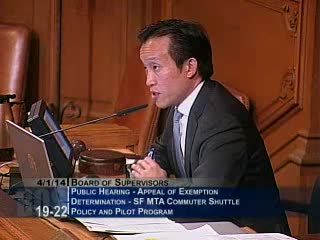
Board upholds SFMTA categorical exemption for commuter-shuttle pilot after hourslong hearing
Summary
After an hourslong public hearing that drew hundreds of speakers and testimony from city staff and outside experts, the Board of Supervisors voted 8–2 to sustain the Planning Department's categorical exemption and allow the SFMTA's 18‑month commuter‑shuttle pilot to proceed.
San Francisco supervisors voted 8–2 on Tuesday to sustain the Planning Department's determination that the San Francisco Municipal Transportation Agency's commuter‑shuttle pilot is categorically exempt from further environmental review under CEQA, allowing the SFMTA to begin an 18‑month pilot that would permit a network of shuttle stops and require participating operators to submit GPS data and pay permit fees.
Why it matters: Supporters said the pilot will bring shuttles into a regulatory framework, reduce single‑occupant vehicle trips and provide the data needed for a longer‑term policy; opponents said the city is legalizing an ongoing, partly illegal practice without an environmental impact report and raised concerns about pedestrian and bicycle safety and displacement.
The appellants, represented by attorney Richard Drury, argued the city should complete a full environmental review before changing the status quo. “Environmental review is supposed to occur before the agency takes action, not after,” Drury told the board, pointing to academic and technical studies he said indicate significant air‑quality, noise, safety and displacement impacts from the wired shuttle operations now on San Francisco streets.
Planning Department staff defended its use of the Class 6 categorical exemption for “experimental management” and information gathering, saying the pilot itself is designed to collect the data that would inform any future, more permanent program. “The proposed pilot program is to explore permitting shared use of Muni stops, and to collect information needed for any subsequent long‑term proposal,” Planning's environmental review officer Sarah Jones said in a written response to the appeal.
SFMTA Director Ed Ryskin said the pilot is intended to regulate an activity that has grown substantially and unevenly over the last several years. “The purpose of this pilot program is to take the information that we have now and respond to the need for regulation,” he told supervisors. SFMTA staff said the pilot would require participating providers to install GPS on vehicles, submit stop and dwell‑time data, and accept operating rules; the agency estimated a $1 per stop event permit fee to recover an initial estimated $1.6 million in start‑up and enforcement costs.
Supporters and opponents: The hearing drew several hours of public testimony. Planning‑area researcher Alexandra Goldman and advocates from tenant and community organizations testified that rental prices and no‑fault evictions have accelerated near some commuter shuttle stops. Supporters from the business and tech community and from some neighborhood merchants testified that the pilot would reduce vehicle miles travelled and greenhouse‑gas emissions by taking commuters out of single‑occupant cars.
Board action and vote: After closing the public hearing, supervisors debated the legal standards for using a Class 6 exemption, including whether an ongoing, partly illegal baseline can be used for the review. The board voted to deny the appeal and allow the pilot to move forward; the roll call showed 8 ayes (Chu, Cohen, Farrell, Kim, Weiner, Yi, Breed, Campos) and 2 noes (Avalos, Tang).
What happens next: SFMTA staff said the pilot is scheduled to begin this summer and will operate for up to 18 months. The agency will identify an experimental network of up to 200 shared Muni stops, hold outreach on specific locations, and submit six‑month status reports for the first three years as required in the adopted rules. Any later, long‑term regulatory program would be subject to environmental review as required.