Get Full Government Meeting Transcripts, Videos, & Alerts Forever!
Get email alerts on the Americas Cup Eir topic
No spam. Unsubscribe anytime.
Board affirms America’s Cup EIR after weeklong hearing; event authority agrees to drop in-water jumbotron
Summary
After hours of testimony and technical dispute over air quality, sediment and funding for mitigation, the San Francisco Board of Supervisors on Jan. 24 affirmed the Planning Commission's certification of the final environmental impact report (EIR) for the America's Cup and related cruise-terminal project, with an amendment underscoring that any "a\
The San Francisco Board of Supervisors on Jan. 24 voted to affirm the Planning Commission's certification of the final environmental impact report for the America's Cup and the James R. Herman Cruise Terminal projects, following a daylong consolidated appeal hearing and extended public comment.
The vote affirmed the EIR as adequate for the decisions before the board and included a written amendment emphasizing that any future, specific long-term development proposals connected to the project will require separate environmental review, which may include supplemental EIRs. The board also agreed to table two procedural motions related to the appeal record for one week.
Why it matters: The EIR ruling clears a key regulatory step that the city and the Port of San Francisco said was necessary for the city to host AC34 races in 2012 and 2013 and to proceed with development of Pier 27 as a cruise terminal. Opponents and environmental groups said the document left open important questions about air quality mitigation, the possibility of disturbing contaminated sediments, the adequacy of monitoring and the certainty of funding for mitigation. The board's amendment and subsequent discussion were intended to put those questions squarely before the city as specific development proposals and transactional approvals proceed.
What the hearing covered and outcomes - Scope and legal form of the EIR: Appellants led by attorney Tom Lippe (representing San Francisco Tomorrow, Golden Gate Audubon, Waterfront Watch, Telegraph Hill Dwellers and the Sierra Club) argued the EIR failed to choose a legally appropriate level of analysis for future, long-term development rights on waterfront parcels and that the document therefore left future decisions vulnerable to legal challenge. Planning staff, the Port and the event authority said the EIR analyzed the immediate projects (the races and the cruise terminal) at the project level and analyzed long-term development rights at a conceptual programmatic level; all parties acknowledged future proposals will require additional environmental review.
- Air quality mitigation: The Bay Area Air Quality Management District urged a fee-in-lieu or an offset fund to pay for replacement of older diesel engines, or alternatively installation of shore-power infrastructure; planning staff said revised analysis and added mitigation reduced some projected impacts but left certain operational emissions (notably reactive organic gases) as significant and unavoidable pending enforceable mitigation. During the hearing the Port reported a proposed agreement with its shipyard tenant at Pier 70 that would make shore-power at Pier 70 feasible and identified an estimated capital cost the Port expects to cover up front and be repaid through a surcharge by the shipyard operator.
- Aquatic Park and the "jumbotron": Swimmers, the Dolphin and South End rowing clubs, open-water users and some environmental commenters pressed the board on the adequacy of sediment disturbance and safety analysis for an in-water jumbotron and temporary barge moorings in the Aquatic Park cove. In response to public concern and repeated questioning, Mary Murphy, counsel to the America's Cup Event Authority, said the authority will amend its permit applications and not pursue a water-based jumbotron and will instead pursue land-based large-screen alternatives.
- Process, funding and monitoring: Many appellants and community members said the EIR and mitigation/monitoring program did not identify firm, enforceable funding sources for some mitigation measures, which they argued could leave environmental protections contingent on uncertain payors. Planning staff noted CEQA requires feasible mitigation measures and performance standards; the city attorney clarified that cost and feasibility questions on particular mitigations are more appropriately resolved when the board considers project approvals and mitigation-monitoring findings.
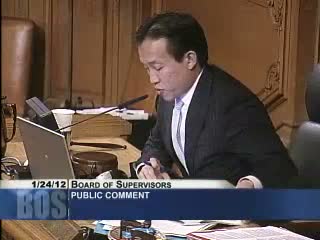
Board action and vote: President Chu opened the motions; President Hsu (acting as motion-maker on the floor) moved to affirm the EIR as adequate, with the amendment that future long-term development proposals will require independent environmental review. Supervisor Cohen moved to table related motions (items 31 and 32) for one week. After discussion and the amendment, the board recorded a roll-call vote to affirm the final EIR as amended (10 ayes, 0 noes recorded) and tabled the related items for further technical work.
Votes at a glance (select items called during the meeting): - Item 30 (EIR for America's Cup / cruise terminal): affirmed as amended; related motions (items 31 & 32) tabled for one week. - Item 6 (resolution to sell city property at Fulton & Goff to the Boys & Girls Club of San Francisco for $2,500,000, subject to covenants and use restrictions): adopted as amended (11 ayes). - Item 5 (ordinance on prevailing rate of wages under city contracts for specified services): finally passed (9 ayes, 1 no). - Item 9 (ordinance to license and regulate commercial dog walkers on park property): passed on first reading as amended (11 ayes) with a cap language revised to an 8-dog hard cap. - Bond measures (Items 12'' 18 and similar appropriations/resolutions for general obligation bonds related to earthquake safety, parks and road repaving): advanced on first readings or adopted as noted in the agenda; see official minutes for precise tallies.
What remained unresolved or under follow-up - Air-quality funding and the Pier 70 shore-power mitigation: Port staff reported a draft agreement with the shipyard operator (BAE) that would allow shore-power installation at Pier 70 and identified an estimated capital cost the Port would initially fund; the Port said the repayment mechanics would rely on a surcharge and a revenue-bond path and that the board would see enabling legislation and the project-specific financing prior to final approvals.
- Sediment testing at Aquatic Park: Planning staff and Port staff said the planned anchoring method would minimally disturb sediments and that the Regional Water Quality Control Board would review permitting; appellants and aquatic-users asked for more explicit sediment testing and monitoring plans tied to permit conditions. The board amendment and subsequent scheduling give staff and appellants time to continue those technical discussions.
- Long-term development rights: The board's amendment makes explicit that conceptual analysis in the current EIR is not a substitute for project-specific CEQA review once concrete long-term development proposals are filed.
Public comment and stakeholder positions: More than a hundred members of the public and dozens of organizations spoke at the consolidated hearing. Supporters included waterfront businesses, unions representing longshore, marine and security workers, cruise and tour operators, and many sailing and boating organizations that said the event and pier improvements would generate jobs, encourage maritime activity and fund needed waterfront infrastructure. Opponents, including San Francisco Tomorrow, Golden Gate Audubon, Waterfront Watch, the Sierra Club and several local rowing and open-water swimming clubs, urged stronger mitigation, tighter monitoring, firmer funding commitments and removal of the in-water jumbotron (the latter was agreed by the event authority during the hearing).
Why the board's amendment matters: By explicitly stating that "further environmental review, which may include one or more EIRs, would be prepared for the specific long-term development proposals," the board signaled that it expects robust, project-level CEQA review for any concrete development proposals that follow from the long-term rights analyzed conceptually in the EIR. That change was intended to reduce legal risk and to reassure community groups pressing for tighter review.
Looking ahead: The board's action clears a major regulatory hurdle for the America's Cup event authority and for the Port's cruise-terminal project, but a number of transactional approvals and financing steps remain. Those items'including the disposition and development agreement, Port enabling actions for Pier 27 and the detailed mitigation-monitoring and financing plans'will come back to the board in the next weeks and months. The Port told supervisors it expected to introduce enabling legislation for the Pier 70 shore-power work and documented financing steps shortly.
Ending note: The hearing underscored how complex waterfront events intersect environmental protection, harbor infrastructure, maritime jobs and city finance. The board's vote affirmed the Planning Commission's technical work while adding a written reminder that conceptual analyses do not replace project-level CEQA review for future long-term developments. The hearing also produced a concrete operational change: the event authority's commitment not to seek a water-based jumbotron, a concession repeatedly requested by swimmers and aquatic users.