Get Full Government Meeting Transcripts, Videos, & Alerts Forever!
Get email alerts on the Wireless Siting topic
No spam. Unsubscribe anytime.
Board affirms CEQA exemption and conditional‑use approval for AT&T site at 4216 California Street
Summary
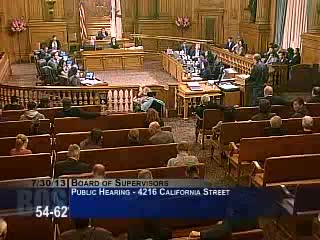
After hours of testimony from neighborhood residents, engineers and AT&T, the Board of Supervisors voted to uphold the Planning Department and Planning Commission on CEQA and conditional‑use issues for a proposed AT&T facility at 4216 California Street. The CEQA exemption and the conditional‑use authorization were both affirmed by 10‑1 votes.
The San Francisco Board of Supervisors on July 30 voted to affirm the Planning Department’s categorical exemption from environmental review under the California Environmental Quality Act (CEQA) and to uphold the Planning Commission’s conditional‑use authorization allowing AT&T to install antennas and related equipment at 4216 California Street. The board affirmed the CEQA exemption 10‑1 and then affirmed the Planning Commission’s conditional‑use authorization 10‑1.
The decision followed a consolidated public hearing that drew several dozen neighbors, technical experts and representatives of AT&T. Appellants and residents urged the board to require CEQA review and to deny the conditional use, arguing the project posed unusual safety and environmental risks tied to the building’s seismic vulnerability and to prior flooding of the structure’s first floor.
Appellant counsel Doug Lauringer told the board the site is “by far the most egregious example I have seen of city agencies bending over backwards to accommodate a wireless carrier by permitting it to operate a wireless facility on a building where it simply does not belong,” citing a 1976 soft‑story wood‑frame building, a 2006 flood that inundated the ground floor and battery placement that appellants said could release lead‑acid electrolyte if inundated. “AT&T equipment should not be permitted on the roof because its presence there raises seismic safety issues,” Lauringer said, and he urged the board to require CEQA review.
Neighborhood residents presented technical reports. Licensed architect and geotechnical consultant L. B. Karp—whose report was submitted as Appellant Exhibit 1—concluded the building’s lateral‑force resisting system is substandard and cannot support additional rooftop loads without a seismic retrofit. Hydrogeologist Matt Hageman reviewed flood risk and concluded that placement of lead‑acid batteries in a location that has flooded in the past could have environmental consequences requiring at least an initial study under CEQA.
Planning Department staff and commissioners argued the record did not show the type of unusual circumstances CEQA requires to deny a categorical exemption. Ann Marie Rogers, the Planning Department’s legislative affairs manager, said the department found “no significant environmental impacts or unusual circumstances” and noted that the proposed batteries would be contained and would meet fire and building code standards, and that sewer upgrades in 2007 reduced the flood risk on the block.
AT&T representatives, including Mark Blakeman, regional vice president, presented coverage analyses and described a significant mobile coverage gap in the neighborhood; AT&T’s technical consultants and third‑party peer reviewers concluded the site was necessary to meet localized capacity and coverage needs. Blakeman said AT&T had already obtained permits to move some rooftop equipment into a ground‑floor equipment room and told supervisors the carrier would raise battery platforms if the city asked; on the record he agreed to elevate the battery rack higher than the six‑inch configuration in early plans if needed.
Board members probed both the technical evidence and the Planning Department’s conclusions. Supervisor Mark Farrell, who moved to affirm the CEQA exemption, said he found the record did not present the type of “unusual circumstances” that would defeat the categorical exemption and noted DBI and the Fire Department retain authority to require seismic and fire safety conditions through the building permit process.
Supervisor Eric Mar was the lone dissenting vote on both the CEQA and conditional‑use actions. The CEQA exemption was affirmed by roll call (Breed, Campos, Chu, Cohen, Farrell, Kim, Tang, Weiner, Yi, Avalos: aye; Mar: no). The conditional‑use authorization was affirmed on a separate roll call by the same split (10‑1).
The board’s approvals were conditioned by the Planning Commission’s prior motion requiring design refinements to reduce visibility of screens and a direction to evaluate methods to seal and raise the equipment room to address potential inundation; the Commission also asked that the equipment room achieve increased fire separation if feasible. Planning staff said those conditions remain in effect as AT&T and city departments finalize building‑permit details.
Opponents said the board’s votes do not eliminate future litigation options. Appellants noted federal and state court precedents that govern municipal review of wireless siting and suggested the record contained disputed technical material. Proponents argued denying the permit would not only leave the coverage gap unresolved but could prompt litigation with constraints on remedies. The board’s two votes conclude the administrative review; further challenges, if any, would be handled in court.
Outcome: CEQA exemption affirmed (item 55) — vote 10‑1; conditional‑use authorization affirmed (item 59) — vote 10‑1. Planning conditions requiring final design work, battery containment and coordination with DBI/Fire/DPW remain in effect.