Get Full Government Meeting Transcripts, Videos, & Alerts Forever!
Get email alerts on the Immigration Detainers topic
No spam. Unsubscribe anytime.
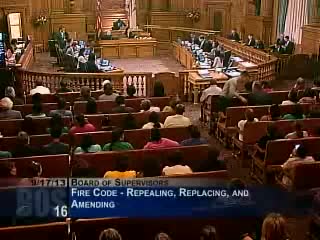
Supervisors delay vote on ordinance limiting holds on civil immigration detainers after week of negotiations
Summary
The Board of Supervisors agreed to continue consideration of an ordinance that would bar local officials from detaining people solely on civil immigration detainers after they become eligible for release. Negotiations produced a narrow set of proposed amendments, and the board set a continuation for Sept. 24 to finalize language.
San Francisco supervisors on Tuesday agreed to continue a major ordinance that would prohibit local law enforcement from detaining people solely on the basis of a civil immigration detainer after the person becomes eligible for release.
The board voted to postpone final action until a future meeting — scheduled for Sept. 24 — after several supervisors and outside stakeholders negotiated a set of amendments intended to narrow situations in which a sheriff or other local official might consider honoring a detainer. The motion to continue was made by Supervisor Kim and seconded by Supervisor Cohen.
The ordinance as introduced by Supervisor David Avalos would amend the administrative code to bar local officials from holding people on civil immigration detainers after they are eligible for release from custody. Supporters said the proposal is intended to protect community members’ trust in public safety agencies so that victims and witnesses will not be deterred from contacting police.
Why it matters
Advocates have argued that cooperation between local law enforcement and federal immigration authorities under programs such as Secure Communities chills reporting of crimes and endangers public safety. Opponents and some public-safety officials said narrow exceptions or “carve-outs” are necessary to allow local authorities to address the most serious violent criminals. The board’s delay is meant to give supervisors more time to finalize language they hope will protect community trust while addressing law enforcement concerns.
What the proposed amendments say
Supervisor Kim circulated draft amendments during the meeting that would: - Restrict consideration of an immigration hold to a limited set of serious offenses (for example, certain violent felonies and human trafficking-related charges) and only when the individual has a prior qualifying conviction and is currently charged with a qualifying offense. - Require the sheriff to weigh evidence of rehabilitation, community ties, victim status (including victims of domestic violence), parental status and other mitigating factors before honoring a detainer. - Include an oversight mechanism: a mandatory written report on the exercise of any discretion to honor detainers and an audit obligation by the sheriff’s office. - Add an automatic sunset for the carve-out (three years or upon the effective date of comprehensive federal immigration reform) and require an initial review within six months of enactment as well as annual reviews thereafter.
Supporters and opponents
Supervisor Avalos, the ordinance sponsor, said the measure is grounded in public-safety goals and constitutional due process protections. “If there is ever a shred of doubt or fear that calling 911 could result in someone being turned over to ICE, we have a chilling effect on public safety,” Avalos said during remarks recorded in the meeting.
Supervisor David Campos urged the board to adopt a version that provides due process protections to all people in the city and cautioned against carve-outs that he said could create unintended consequences. “The right place to address public-safety concerns is through the criminal justice system, not by making local government an arm of immigration enforcement,” Campos said.
Supervisor Kim said her draft attempted to narrow any exception as much as possible so that law enforcement discretion is tightly constrained and subject to oversight.
Next steps
Supervisors voted to continue the matter to the Sept. 24 board meeting so final language can be prepared and distributed to members. The motion to continue was seconded by Supervisor Cohen and adopted without objection. If the board reaches agreement, the item will return for a final vote.
Speakers quoted in this article are identified by their titles as recorded in the meeting transcript.