Get Full Government Meeting Transcripts, Videos, & Alerts Forever!
Get email alerts on the Public Health Budget topic
No spam. Unsubscribe anytime.
Large public opposition as DPH presents proposed cuts to HIV, behavioral health services
Summary
At a public hearing required under budget law, the Department of Public Health outlined planned contract reductions and a reorganization that would close one skilled nursing unit and shift services; community groups and clients urged the board to restore federal shortfalls, notably $3 million in HIV funding, and voiced concerns about impacts on L
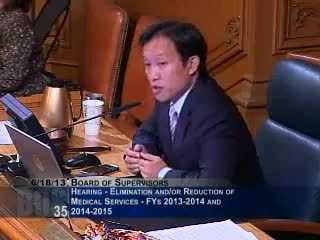
The San Francisco Department of Public Health (DPH) outlined proposed reductions and a reorganization of behavioral health services during a required public hearing, prompting sustained public testimony opposing cuts to HIV/AIDS prevention and care, substance use treatment and mental-health services.
DPH Director Barbara Garcia described two broad drivers of change: federal reductions in HIV/AIDS and TB funding and internal efforts to prepare the department for health-care reform by shifting resources toward revenue-generating services. She told the board the department planned a new competitive procurement process (an RFP) that would reduce an identified community services base and would close one of two skilled nursing units on the San Francisco General Hospital campus, then reorganize the services that support discharges from the hospital. "These will be proposed by an $8,800,000 reduction in fiscal year '14–'15 that annualizes into $17,600,000 in 2015–16," Garcia said, and noted additional federal cuts in HIV funding totaling about $3 million that remained unbackfilled in the mayor’s proposal.
Supervisors and public speakers focused on the possible effects. Supervisor Scott Wiener and Supervisor David Campos pressed for full restoration of federal Ryan White and CDC prevention shortfalls. Wiener described a multi-year pattern of federal reductions that had already been backfilled in part by the mayor and the board; Campos warned that community agencies that serve vulnerable populations would face "devastating" impacts if the remaining $3 million in federal cuts were not restored. Supervisor Malia Cohen and others asked about the planned closure and how patients would be placed; Garcia replied that 34 skilled nursing beds existed at the facility in question and that only about 12 patients met Laguna Honda Hospital’s admission criteria and would therefore move there; others would be placed with community providers, she said.
Hundreds of speakers and representatives from nonprofits, health-care providers and advocacy groups addressed the board in two hours of public comment. Testimony came from DPH contractors and clients that provide or rely on HIV care and supportive housing, hospice and transitional programs, and specialized services for people who use drugs and who are living with HIV. Examples of public testimony: - Patrick Monette Shaw (private citizen/advocate) urged the board to return the behavioral health reconfiguration to DPH for further review and criticized what he called a lack of public process; - Vivian Imperiali, past president of the National Alliance on Mental Illness (NAMI), warned closing the behavioral health center floor or moving patients to Laguna Honda Hospital would undermine specialized psychiatric care and recovery-focused environments and make patients feel ‘‘permanence, not recovery’’; - Representatives from Michael Smithwick’s MyTree/MiTre (residential hospice and long-term care for people with advanced AIDS) and other providers described how further reductions would reduce bed capacity and likely force providers to leave beds empty or otherwise ration care; several residents and clients testified that supportive housing and hospice programs had been lifesaving.
Public-health contractors and community clinics described measured outcomes and the economic case for restoration: Project Open Hand, API Wellness Center, Shanti, Larkin Street Youth Services, Stonewall Project and many Latino providers (Aguilas, Instituto Familiar de la Raza among others) said their prevention and care services create viral-load suppression, reduce hospitalizations and prevent higher downstream costs.
Director Garcia and department staff reiterated that some cuts resulted from federal decreases, and that the RFP-driven reductions were intended as a reconfiguration for long-term sustainability as the city transitions under the Affordable Care Act. She also clarified the behavioral health reorganization was expected to include a residential-care redesign and psych respite services and that the department would follow Laguna Honda admissions policy when transitioning patients.
The hearing—required under state and city budget rules—recorded extensive public testimony but did not produce a board vote at the meeting. Several supervisors pledged to continue working with the mayor to try to backfill remaining federal HIV funding and to scrutinize the RFP process, while community groups pledged follow-up advocacy.