Get Full Government Meeting Transcripts, Videos, & Alerts Forever!
Get email alerts on the Mobile Food Regulation topic
No spam. Unsubscribe anytime.
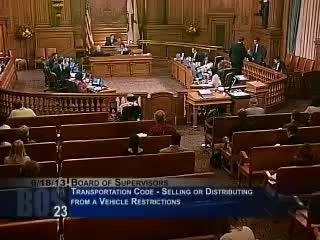
Board advances package to regulate food trucks, limit proximity to restaurants and schools
Summary
San Francisco supervisors advanced a package of ordinances to modernize rules for mobile food facilities, aiming to reconcile tensions between food trucks, brick-and-mortar restaurants and neighborhoods.
San Francisco supervisors advanced a package of ordinances to modernize rules for mobile food facilities, aiming to reconcile tensions between food trucks, brick-and-mortar restaurants and neighborhoods.
Supervisor Scott Wiener introduced the legislation and said it was the product of nearly two years of negotiation among food-truck operators, restaurant and property owners, and several city commissions. "This legislation results from almost exactly two years of work, of negotiation, of compromise," Wiener said. He described the package as a compromise that will "move us in the right direction in terms of our food scene."
The ordinance package, which the board took on the consent calendar and passed on first reading without objection, includes multiple changes: - Establishing a 75-foot minimum distance between a food truck and the nearest entrance to a brick-and-mortar restaurant; - Requiring improved notice to surrounding neighborhoods and periodic renewal of food-truck permits; - Limiting a truck to a maximum of three days at a single location; - Creating controls on so-called formula retail to prevent chain-operated food-truck concepts from displacing local vendors; - Allowing parking-control officers to enforce Department of Public Works (DPW) notices and enabling violations to be processed through DMV collections; and - Changing the treatment of food trucks on college and hospital campuses and adjusting long-standing school-zone buffers (reducing the prior 1,500-foot buffer to 500 feet around middle schools and generally 1,000 feet around high schools, with some exceptions at commercial high schools).
Wiener argued the changes would create predictability in permitting and enforcement. "The legislation will bring clarity and predictability to the process," he said, noting DPW has lacked enforcement staff and that empowering parking-control officers would make enforcement more effective.
Supporters from the board described the need to balance entrepreneurs entering the food industry — Wiener noted the role of incubator programs such as La Cocina — with protecting school lunch programs and neighborhood restaurants. Supervisor Mar said she supported the amendments and praised Wiener’s efforts to balance competing interests and to protect students’ access to healthy school lunches. Supervisor Jane Kim said the district offices had mixed feelings about differing buffers for high schools and said she expected ongoing review of the ordinance’s effects.
Wiener told the board the package had been vetted by the Planning Commission, the Small Business Commission and the Youth Commission, each of which endorsed it. After discussion and several supervisors’ statements of support, the board approved the ordinances on first reading as a legislative package. Final hearing and implementation details, including enforcement staffing and a schedule for permit renewal, remain with the implementing departments.
The measures will return for subsequent readings and implementation steps with DPW and the Planning Department coordinating permit and enforcement updates.