Get Full Government Meeting Transcripts, Videos, & Alerts Forever!
Get email alerts on the Code Enforcement Graffiti topic
No spam. Unsubscribe anytime.
After public outcry over fines, board accepts DPW's amended report of blight-assessment costs
Summary
The Board of Supervisors accepted an amended Department of Public Works report of assessment costs under Administrative Code Chapter 80 after a public hearing in which property owners complained about repeated graffiti, unclear notices and assessment procedures.
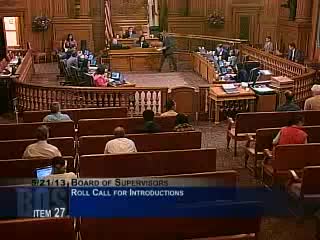
The Board of Supervisors held a committee-of-the-whole hearing May 7 to consider objections to a report of assessment costs filed by the Department of Public Works under Administrative Code Chapter 80 (Community Preservation and Blight Reduction Act). The report lists properties for which the city performed graffiti and blight abatement and proposed assessments to be placed on the tax roll.
Gretchen Rood and Linda Lee Robbins of DPW's Graffiti Unit summarized the unit's process: property owners are notified by posting, regular mail and certified mail; owners are given 30 days to abate graffiti (and an additional 15 days when posted as blight); when owners fail to act, the city performs abatement and seeks cost recovery through assessments. After public comment and follow-up conversations with DPW staff, the department returned to the chamber and reported that eight properties had been resolved, and that lines on the initial list had been crossed out because the matters had been dismissed or paid.
Dozens of members of the public spoke in the hearing, reporting repeated tagging on properties and concerns that the city's notification and customer service processes were inadequate. Speakers included property owners and managers who said they received bills for graffiti abatement without clear notice of specific incidents or adequate photos, had difficulty contacting DPW staff, and worried that penalties exceeded the cost of private cleanup. Jerome Belac told the board he was repeatedly unable to reach DPW staff and that postings sometimes did not specify where on a large parcel graffiti existed. Peter Schafer and other property owners asked for more enforcement against perpetrators rather than repeated fines on property owners; several suggested stakeouts, cameras, or targeted enforcement.
DPW staff described a hardship program for property owners who are the targets of repeated graffiti: owners can request a hearing, and if an administrative law judge finds in their favor the department can assist with abatement for up to six months while they pursue longer-term remedies. DPW recommended quick abatement, anti-graffiti coatings, improved lighting, motion sensors, cameras or murals as mitigation strategies.
After DPW returned with an amended list (eight properties resolved), the board, by roll call, accepted the amended report of assessment costs. The clerk recorded 11 ayes on the final vote.