Get Full Government Meeting Transcripts, Videos, & Alerts Forever!
Get email alerts on the Nightlife And Entertainment topic
No spam. Unsubscribe anytime.
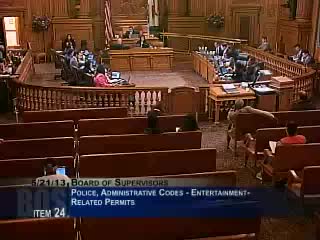
Board advances entertainment-code changes to expand live-permit types, give commission new enforcement tools
Summary
The Board of Supervisors passed, on first reading, a package of changes to entertainment and noise rules that expands limited live-performance permits, creates a 90-day temporary entertainment permit and strengthens enforcement powers of the Entertainment Commission.
The Board of Supervisors passed, on first reading, amendments to the city's entertainment and noise regulations aimed at expanding opportunities for live performance while giving regulators new enforcement tools.
Supervisor Scott Wiener, the legislation's sponsor, said the package would "increase access to live entertainment," streamline permits for small venues and give regulators authority to act more quickly against serious violations. Wiener said the legislation would extend limited live-performance permits to outdoor spaces like patios and courtyards, and explicitly allow venues to obtain limited permits for DJs. He described a new 90-day temporary place-of-entertainment permit to keep businesses operating while a permanent place-of-entertainment permit is processed.
Wiener said the measure would increase enforcement flexibility: it raises the director's temporary suspension authority from seven to fifteen days so the suspension can cover two weekends, permits the Entertainment Commission to require sound tests as permit conditions, and for the first time authorizes the commission to cite operators who are operating without a permit. Wiener also said the Department of Public Health would be empowered to cite some unamplified noise violations in public spaces.
President David Chiu offered an amendment clarifying that a prior 15 percent cap on year-over-year increases in extended-hours permits (enacted in 2009) should apply to premises that provide entertainment, not to food-and-beverage establishments that do not provide entertainment; the amendment passed, with Supervisor Wiener seconding. The ordinance passed on first reading "same house, same call," the president said; the measure will return for further consideration under the board's ordinance process.
Supporters argued the measure strikes a balance between preserving nightlife and protecting neighbors. The legislation had unanimous support from the Entertainment Commission and the Small Business Commission, Wiener said.