Get Full Government Meeting Transcripts, Videos, & Alerts Forever!
Get email alerts on the Pension Divestment topic
No spam. Unsubscribe anytime.
Board urges retirement system to cease new fossil‑fuel investments and divest public holdings within five years
Summary
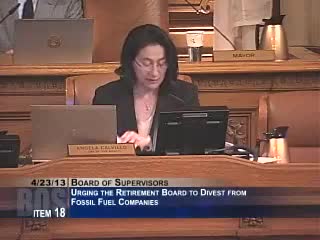
The San Francisco Board of Supervisors unanimously adopted a nonbinding resolution on April 23 urging the San Francisco Employees’ Retirement System to stop new public investments in fossil‑fuel companies and begin phased divestment of its public holdings within five years.
The San Francisco Board of Supervisors on April 23 unanimously adopted a resolution urging the San Francisco Employees’ Retirement System (SFERS) to stop new investments in publicly traded fossil‑fuel companies and to divest existing public holdings within five years.
Sponsor and vote: Supervisor John Avalos introduced the resolution; it was amended during floor debate and then passed by the full board by unanimous consent. The transcript records a unanimous board outcome.
Why it matters: Sponsors and backers said divestment responds to climate risk and a potential ‘‘carbon bubble’’ in fossil‑fuel valuations. Supporters cited estimates of the Retirement System’s exposure and outside analyses about financial risk from constrained fossil‑fuel extraction.
What the resolution asks: The resolution urges the Retirement Board to (a) cease new public investments in a set of fossil‑fuel companies and (b) develop a plan to divest existing public holdings over a multiyear period (the resolution’s text calls for a phased approach and suggested a five‑year timeframe). The resolution is nonbinding; the Retirement Board has independent fiduciary responsibilities.
Key figures and evidence cited at the hearing: Sponsor testimony cited an SFERS staff estimate and supporting materials stating the system’s $15.6 billion portfolio included roughly $583.7 million in public holdings among the top 200 fossil‑fuel companies, including $112 million in Exxon and $60 million in Chevron. Sponsors also cited reports from HSBC, Citibank, Standard & Poor’s, the International Energy Agency and the Asset Owners Disclosure Project about long‑term valuation risks for fossil‑fuel reserves. An investment management firm (Aperio Group) was cited for back‑tests showing fossil‑fuel‑free portfolios performing at or above benchmarks for many historical 10‑year rolling periods.
Amendment and process: During debate Supervisor Farrell moved to remove a further‑resolve clause from the text (a motion to amend); Supervisor Abalos seconded the motion. That amendment was accepted by the board without objection; other supervisors offered additional edits that staff and co‑sponsors incorporated on the floor. Supervisor Aaron Peskin? No—(transcript names) multiple members spoke in support and urged prudential, phased action to respect fiduciary obligations.
Opposition and cautions: Several supervisors acknowledged the merits of the policy but warned of fiduciary duties and potential reinvestment risks. Supervisor Tang and others said the Retirement Board must proceed prudently and that gradual divestment would require careful reinvestment planning. Supervisor Cohen—serving as a board appointee to the Retirement Board—said she would carry the board’s views to the Retirement Board but reminded colleagues the measure is a nonbinding statement and that formal divestment would be a multistep process.
Outcome: The board adopted the amended resolution by unanimous consent. The measure is advisory; it requests the Retirement Board consider and report on divestment options consistent with fiduciary duties.
Ending: Sponsors described the resolution as part of a broader climate strategy and urged the Retirement Board to consider reinvesting in renewable energy and local jobs while protecting retirees’ interests.