Get Full Government Meeting Transcripts, Videos, & Alerts Forever!
Get email alerts on the Capital Plan topic
No spam. Unsubscribe anytime.
Board adopts 10-year capital plan; supervisors warn Muni needs far exceed plan
Summary
The San Francisco Board of Supervisors adopted a 10-year capital expenditure plan but several supervisors, led by Supervisor Wiener, said the plan underfunds the city's public transportation needs, which the plan itself estimates at more than $2 billion in unmet capital needs for Muni.
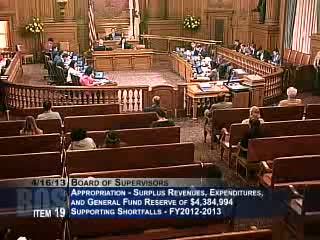
The San Francisco Board of Supervisors on April 16 adopted a 10‑year capital expenditure plan covering fiscal 2013–14 through fiscal 2022–23 pursuant to Administrative Code Section 3.20.
The plan passed on a same‑house, same‑call vote after members praised the capital planning process while several cautioned it does not allocate sufficient funding for the city's public transportation system.
President Chu thanked the capital planning committee and staff for assembling the plan and noted broad participation from departments and neighborhoods across the city.
"Over the past five years voters have approved $1,900,000,000 of general‑obligation bonds for hospitals, parks, police and firefighters and streets," President Chu said, highlighting recent voter support for capital work.
Supervisor Wiener said he will support the plan in committee and on the floor but warned it falls short on transit. "If you look at the capital plan, the investment in our public transportation system is woefully inadequate," Wiener said. He cited the plan's own estimate that Muni has more than $2,000,000,000 in unmet capital needs and said the capital plan contemplates spending only a small fraction of that amount.
Wiener said the city has neglected its transit system and that the plan reflects a broader lack of prioritization for public transportation. He urged further work to identify revenue options, including the possibility of a general‑obligation bond or a vehicle license fee targeted to transit, noting uncertainty about whether such revenues would actually be directed to Muni.
Despite his concerns, Wiener said he would support the capital plan as "a small step in the right direction" and expressed hope the council would revisit funding after the ongoing 2030 Transportation Task Force completes its work.
The resolution adopting the plan was approved by the board on the same‑house, same‑call motion; the transcript does not record a roll‑call tally for item 20.
Why it matters: The capital plan sets spending priorities for the next decade across city departments. Supervisors’ statements highlight a potential funding gap for transit that could affect service, fleet replacements and reliability as the system ages.