Get Full Government Meeting Transcripts, Videos, & Alerts Forever!
Get email alerts on the Education Funding topic
No spam. Unsubscribe anytime.
Board approves $2.205 million school supplemental split between school baseline and state reserve after debate over funding sources
Summary
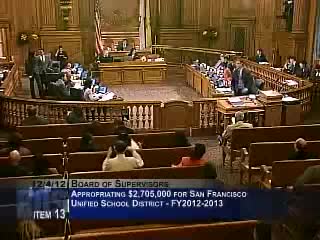
Supervisor Kim asked the Board to appropriate funds to help San Francisco Unified School District students who are off track to graduate; the board approved a reduced $2.205 million supplemental after amendments and separate roll call votes on funding sources.
Supervisor Kim advanced an ordinance to appropriate funds to the San Francisco Unified School District for programs aimed at getting juniors and sophomores back on track to graduate. Kim said updated district data showed roughly 2,000 juniors were off track and she proposed a supplemental originally for approximately $2.7 million; amendments negotiated during the meeting reduced the request to $2.205 million.
Supervisor Kim explained the reduction came from two sources: the district identified $200,000 of internal savings and agreed to cut $250,000 from an intended allocation, and she proposed a revised funding split so $1,412,000 would come from the school district set‑aside (Public Education Enrichment Fund, sometimes called PEAF or Prop H funds) and the remainder from the state revenue loss reserve (the state reserve figure was discussed at $843,000 in the amendment language, later clarified in discussion). Kim and the Mayor's budget office described the split as a compromise intended to both deliver funds promptly for programs beginning in the spring semester and protect broader reserves.
The board debated process and source choices. Several supervisors said they supported the objective of funding credit recovery and targeted supports but disagreed about whether the city should draw from state reserve funds or use school rainy day/PEAF monies. Supervisor Chiu and others urged using PEAF and rainy day funds to preserve the city's flexibility in the face of potential state and federal cuts; the Mayor's budget office said the Mayor preferred a combination that used PEAF baseline funds plus rainy day funds rather than the state revenue loss reserve. Controller Ben Rosenfield clarified the amendment did not draw from the formal rainy day reserve for schools but rather used available balances in the public education baseline.
Procedurally the board voted to divide the funding question so the PEAF portion and the state revenue loss reserve portion were voted on separately. The PEAF portion ($1,412,000) passed on roll call (11 ayes). The state revenue loss reserve portion ($843,000) passed separately (7 ayes, 4 noes). Both portions were therefore approved and the ordinance passed on first reading. The Clerk recorded that the appropriation as amended would be executed and the items would be forwarded consistent with normal ordinance second‑reading processes.
Why it matters: Supervisors described the appropriation as a short‑term, targeted intervention to fund credit recovery, expanded counseling, evening classes and other supports to help about 2,000 juniors and sophomores who the school district identified as off track to meet A–G college readiness requirements. The funding decision also highlighted a recurring board question: which city reserves should be used for one‑time school supplements versus preserved for potential state or federal shortfalls.
Next steps: The ordinance passed on first reading and will return for a second reading per the board's calendar; the school district and city staff said they planned to implement programs in the upcoming spring semester for impacted students.