Get Full Government Meeting Transcripts, Videos, & Alerts Forever!
Get email alerts on the Central Subway topic
No spam. Unsubscribe anytime.
Board approves eminent‑domain resolutions for most Central Subway property licenses after contested hearing
Summary
After a full public hearing and testimony from the SFMTA and property owners, the Board of Supervisors voted to adopt eight of eleven proposed resolutions of necessity to acquire temporary construction licenses for the Central Subway project and tabled three items while negotiations continue.
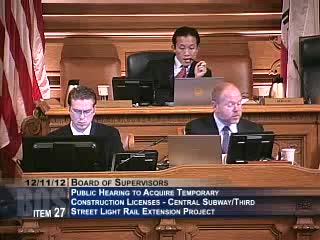
The San Francisco Board of Supervisors on Dec. 11 held an extended public hearing on resolutions of necessity to acquire temporary construction licenses by eminent domain for properties needed for the Central Subway Third Street light‑rail extension and approved the majority of the measures.
The board convened as a committee of the whole to hear the San Francisco Municipal Transportation Agency’s presentation, testimony by property owners and public comment. The board voted to adopt eight resolutions of necessity (items 28, 30–35 and 38 on the agenda) and to table three related items (items 29, 36 and 37) so negotiations with their owners could continue.
The SFMTA said the temporary licenses are needed to install thin‑walled subsurface grout tubes and interior/exterior settlement monitoring equipment to protect adjacent buildings during excavation and tunneling. John Fungi, identified in the hearing as Central Subway program director, told the board the program anticipates installing grouting tubes in June of next year and would use monitoring equipment through construction, which SFMTA projects will finish in December 2018. “These licenses are temporary in nature,” Fungi said, “and will allow us to install preventive measures that will allow the city to protect existing buildings.”
Property representatives urged the board to postpone or reject the condemnations for several sites and cited missing temporal limits in the draft license text provided in the resolutions. Mark Seifert, representing owners of the property at 1 Stockton Street (the Apple flagship store) and 212 Stockton Street (Bulgari and other tenants), told the board the version of the license included in agenda exhibit A lacked explicit time limits and therefore read as a perpetual easement rather than a temporary construction license. Seifert also said that appraisal work provided to owners did not account for severance damages and that the city had not adequately responded to written comments submitted months earlier.
SFMTA and Planning Department staff told the board they had been negotiating with property owners, that offers had been made under the Government Code, and that SFMTA staff would continue to negotiate to avoid litigation. The agency said work is time‑sensitive because monitoring and grouting protect structures during planned construction windows.
After hearing the SFMTA presentation and property owner statements, Supervisor Campos moved to table the items for properties where agreements had been reached and to proceed on the remaining eight resolutions. The board voted to table items 29, 36 and 37 (the properties later identified by staff as having agreements) and to adopt the remaining eight resolutions of necessity on a roll call that recorded 11 ayes.
Votes at the hearing were recorded on the official roll call for the adopted resolutions: 11 ayes, 0 noes. The tabling of the three items occurred by motion and without objection; the clerk recorded the continuation rather than a roll‑call vote.
What the board did not do was permanently condemn every parcel. Several owners emphasized they prefer to reach negotiated license agreements with SFMTA rather than litigate. The MTA said it will continue negotiations and use monitoring and mitigation measures while talks proceed.