Get Full Government Meeting Transcripts, Videos, & Alerts Forever!
Get email alerts on the Public Health topic
No spam. Unsubscribe anytime.
Board advances bed‑bug ordinance requiring landlord disclosures and monthly pest‑control reporting
Summary
The San Francisco Board of Supervisors passed an ordinance on first reading to strengthen the city's bed‑bug response by requiring clearer tenant/landlord information, limited disclosure of prior infestations on request, and monthly reporting from pest‑control operators to the Department of Public Health.
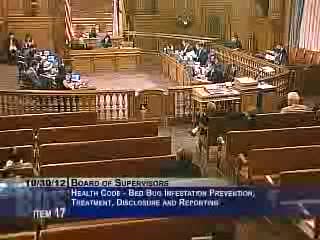
The San Francisco Board of Supervisors passed an ordinance on first reading on Oct. 30 to amend the city's health code with new requirements for bed‑bug prevention, disclosure and reporting.
Supervisor Kim, author of the measure, told the board the ordinance is “a culmination of 3 years of work, from residents, advocates, property managers, pest control operators, and city departments.” The legislation requires the city to provide “clear and accessible information on how to properly abate bed bug infestations and the roles and responsibilities for tenants, landlords, and pest control operators,” Kim said.
The ordinance contains three core provisions described in committee and at today's meeting: (1) a citywide requirement to publish and make accessible guidance on bed‑bug abatement and responsibilities for tenants and property owners; (2) a disclosure provision, modeled on a New York City administrative‑code requirement, that allows a property owner or manager to provide a prospective tenant with a written history of infestations and abatement on request; and (3) a mandate that pest‑control operators submit monthly reports to the Department of Public Health (DPH) on the number of units treated so the city can better track where infestations are increasing.
“By mandating that pest control operators have to report to DPH, we'll have a broader sense of where the infestations are,” Supervisor Kim said, adding that the data will allow the city to “prioritize neighborhoods in which infestation seems to be increasing and prioritizing our limited staff resources to where the need is.”
Supervisor Weiner thanked Kim and the advocates who worked on the measure and said tenant education should be part of the overall strategy. “I think it's appropriate to put the responsibility for remediation on the landlords, but I think it's also important to make sure that we're educating tenants about how to avoid bed‑bug infestation,” Weiner said.
Kim and other supervisors noted the ordinance was developed with input from the Department of Public Health, the Department of Building Inspection, the SRO collaborative and a multiyear working group that included residents, property managers and pest‑control professionals. Kim told the board the city currently relies primarily on complaint data and that the new reporting requirement is intended to give public health officials a broader evidence base.
At the meeting Kim cited existing local resources the city can use in implementation — including 16 healthy housing inspectors and two DPH inspectors focused on SRO buildings — but did not tie the ordinance to a specific new funding appropriation at this hearing.
The measure passed on first reading by the board “same house, same call.” Because the vote was taken by unanimous consent at the hearing, a roll‑call tally for this first reading was not recorded in the transcript. The ordinance will return for subsequent readings and any final vote required under city legislative procedures.
Implementation and next steps described by Kim and others include finalizing the reporting format for pest‑control operators, creating the tenant/landlord guidance materials, and coordinating enforcement and outreach with DBI and DPH. No specific implementation timeline or enforcement penalties were specified at today's first reading.
The board received public support and general praise from colleagues during the item; no formal amendments were offered during the floor discussion. The measure will be scheduled for committee and later readings before a final adoption vote.