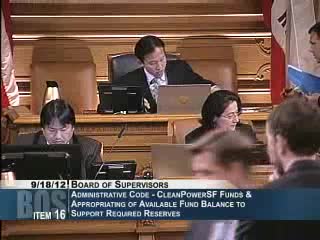
Board approves launch of Clean Power SF, authorizes $19.5 million appropriation and Shell contract
Loading...
Summary
The San Francisco Board of Supervisors on a divided vote approved an ordinance and resolution to launch the city's Clean Power SF community choice aggregation program, appropriating $19.5 million and authorizing a five-year contract with Shell Energy North America to supply power for program start-up.
San Francisco's Board of Supervisors voted to approve legislation to launch Clean Power SF, the city's community choice aggregation (CCA) program, and to appropriate $19.5 million of Hetch Hetchy fund balance to support the program.
The launch package passed after amendments, with supervisors voting 8 in favor and 3 opposed on the balance of Items 16 and 17. The board separately approved a $6 million portion of the appropriation that will fund sustainability services and outreach by unanimous vote.
The ordinance (Item 16) establishes a Clean Power SF customer fund and a reserve fund and appropriates $19,500,000 of Hetch Hetchy fund balance at the Public Utilities Commission (SFPUC) to support the CCA program. The companion resolution (Item 17) authorizes the SFPUC, subject to conditions, to launch the program, approve local sustainability services for Clean Power SF customers and authorize the SFPUC general manager to execute a contract with Shell Energy North America for a term of up to five years to supply power needed to launch the program.
Ed Harrington, general manager of the San Francisco Public Utilities Commission, told the board the program will start with about 90,000 participants and a 30-megawatt initial supply portfolio that will be 100 percent renewable "on a megawatt-hour basis." Harrington said the city will initially buy renewable energy from Shell under the proposed contract, and over time the city expects to build out local generation.
"This program is the single program that has any chance to make a big dent" in San Francisco's greenhouse-gas goals, Harrington said, and described the appropriation as a highly efficient way to achieve emissions reductions citywide. He said the appropriation includes funding for incentives and outreach: roughly $2 million for energy-efficiency initiatives, $2 million for solar incentives and $1 million for education and outreach, among other items.
Several supervisors pressed SFPUC and city attorneys on program details. The primary technical sticking point during debate was the state's opt-out structure for CCA programs, which the board cannot change. Supervisor David Chiu and Supervisor Jane Kim proposed amendments intended to give the SFPUC authority to phase the initial rollout toward customers who had indicated interest and to begin recovering required program reserves through Clean Power SF rates over time. The board approved Kim's low-income and outreach protections, and approved a separate amendment directing the SFPUC to recommend including a component in Clean Power SF rates to begin recovering reserves; a Chiu amendment requiring an explicit customer interest threshold before committing to buy from Shell failed.
Supervisor Kim emphasized protections for low-income and limited-English speakers, including excluding low-income customers from the initial phase unless the SFPUC can ensure low-income discounts similar to PG&E's CARE program and directing priority for energy-efficiency and solar incentives to low-income customers. Harrington said the SFPUC will focus early marketing in precincts that polling shows have the highest interest and that neighborhoods with lower interest, such as parts of Chinatown, would not be included in the initial phase.
On rates, Harrington presented SFPUC's estimates that participation would raise the average residential bill citywide by roughly $18 per month (about a 23% increase on the total PG&E bill for typical usage), with lower-usage households seeing a smaller dollar increase and higher-usage households seeing a larger one. He said the program's goal is not to remain dependent on third-party suppliers but eventually to finance and build local generation and thus gain control of energy cost and supply.
Supervisor Mark Farrell and others argued the opt-out framework risks enrolling residents who do not understand the program and pressed for stronger safeguards; some supervisors attempted late amendments to require a pre-marketing sign-up before committing to buying power, but those measures failed. Supervisor Scott Wiener moved to continue the item for one week to resolve opt-in/opt-out language; that motion failed 7-4.
Supervisor Farrell moved to sever and vote separately on the $6 million in the appropriation for sustainability services (education and targeted programs); that portion passed unanimously. After considering further amendments and debate, the board adopted the ordinance on first reading and the resolution authorizing the SFPUC to launch Clean Power SF and execute the contract as amended.
The board directed the SFPUC to undertake an extensive multilingual outreach campaign focused on low-income communities and to give priority to low-income customers for the program's energy-efficiency and solar incentives. The SFPUC will also recommend a rate component to begin recovering program reserves during the contract period.
The SFPUC and city attorneys said the contract with Shell is the only viable supplier available in the near term to meet CCA procurement needs; the SFPUC said it searched for alternatives.
The SFPUC estimates the program can begin delivering power in spring of the following year if the board's approvals move forward through the remaining administrative steps.
Votes at a glance - Item 16 (Ordinance establishing Clean Power SF customer and reserve funds; appropriating $19,500,000 of Hetch Hetchy fund balance): passed on first reading (vote on balance of item after severing $6 million: 8 ayes, 3 noes). The $6 million portion for sustainability services was approved separately (11-0). - Item 17 (Resolution authorizing SFPUC to launch Clean Power SF and authorizing contract with Shell Energy North America): adopted (8 ayes, 3 noes).
What comes next: The SFPUC will carry out outreach and begin marketing phases as authorized. The ordinance passed on first reading and the board and SFPUC staff said further regulatory and contracting steps and rate-setting will follow before power delivery begins.