Get Full Government Meeting Transcripts, Videos, & Alerts Forever!
Get email alerts on the Small Business topic
No spam. Unsubscribe anytime.
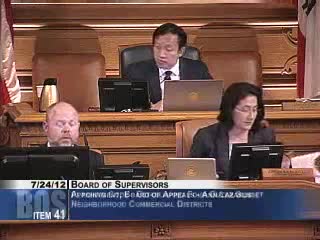
Board approves Outer Sunset neighborhood‑commercial districts and trade‑shop rule changes on first reading
Summary
Supervisors approved an ordinance creating four Outer Sunset neighborhood commercial (NC) districts and relaxed some zoning limits on small-scale trade shops while adding noise and odor controls; vote 10–0 on first reading.
The Board of Supervisors approved on first reading an ordinance establishing four named Outer Sunset neighborhood commercial districts and modifying how small-scale manufacturing and “trade shops” are regulated in those districts.
The legislation creates neighborhood commercial districts on Taraval, Judah, Irving and Noriega Streets, increases ground-floor height allowances by five feet, and establishes a conditional‑use process for non‑active ground‑floor uses. The ordinance relaxes some limits on trade shops — increasing allowable mechanical‑equipment footprint from one‑third to two‑thirds of a unit and removing a 5‑horsepower cap — to give local makers and small manufacturers more flexibility to operate in commercial corridors.
Supervisor Carmen Chu and sponsor Stephanie (Supervisor Chu spoke) said the measure aims to support small businesses and local manufacturing, referencing SFMADE and the Office of Small Business as partners in shaping rules that would allow artisans and trade shops to locate in neighborhood commercial strips. The planning commission recommended several modifications; the sponsors incorporated many of the commission’s suggestions and inserted specific language to require mitigation for noise, odor and garbage.
Supporters said the rules were designed to keep large manufacturing operations out (trade shops remain capped at 4,000 square feet), while allowing more flexible operations that could fill empty storefronts and help neighborhood economies. The measure passed first reading with a unanimous roll‑call vote (10 ayes) and will return for additional readings and final adoption.
The board and sponsor noted plans for follow‑up legislation to address vibration controls and other operational details, and staff said they had coordinated with the Office of Small Business and local merchants associations during drafting.