Get Full Government Meeting Transcripts, Videos, & Alerts Forever!
Get email alerts on the Elections topic
No spam. Unsubscribe anytime.
Supervisors debate repeal of ranked-choice voting, divide competing charter measures and continue to July
Summary
The San Francisco Board of Supervisors debated a charter amendment to replace ranked-choice voting for citywide offices with runoff elections, heard multiple amendment proposals and agreed to divide the file into competing measures and continue consideration to a committee of the whole in July.
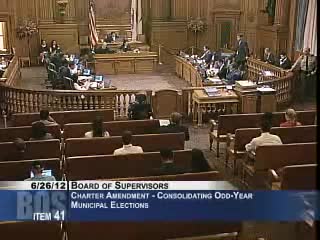
The San Francisco Board of Supervisors on Tuesday debated a charter amendment that would end ranked-choice voting (RCV) for citywide offices and replace it with various runoff formats, then voted to divide the proposal into competing measures and continue the matter to a committee of the whole in July.
Supervisors spent more than two hours debating alternatives to RCV, including limiting a repeal to the mayoral race, creating a September primary tied to a November runoff, and a version that would retain RCV for an initial election and send the top two candidates to a later runoff. The board ultimately agreed to divide the file into separate versions — the original proposal, a version with an amendment introduced by President Chu, and a version offered by Supervisor Olague — and continue all versions for further amendments and public review.
Why it matters: The change would alter how San Franciscans choose citywide officials and could affect turnout, campaign strategy and the timing of future mayoral elections. Supporters said runoffs would make it easier for voters to distinguish between two finalists; opponents said RCV increases participation, reduces negative campaigning and better represents diverse neighborhoods.
Supervisor Campos opened the discussion by saying the repeal effort should be treated as a compromise and warned against rushing to place a measure on the ballot: "Why do we need to put a measure on the ballot in the year 2012? ... We have plenty of time for us to work on a compromise," he said.
Supervisor Wiener defended moving toward a runoff system and framed the current divided-file compromise as already scaled back from an earlier proposal: "Just to be clear, what's before us today is already a compromise... going back to the runoff system is the better way of ensuring maximizing voter engagement," Wiener said.
Several supervisors urged caution. Supervisor Campos and Supervisor Mar said data do not clearly show RCV causes the harms its critics describe, and Supervisor Mar warned that runoffs could "privilege the more wealthier funded candidates over grassroots" campaigns. Supervisor Kim asked why the proposal uses a 65 percent threshold for a September outright win, noting most runoffs rely on a simple majority: "There doesn't seem to be a basis or formula at which we pick that number."
President Chu (introducing an amendment) and others said the 65 percent threshold was a negotiated compromise meant to make it difficult to win outright in a lower-turnout September election. Chu said stakeholders suggested the percentage to reduce unintended consequences of a low-turnout primary.
Several amendment motions were offered on the floor: an amendment by President Chu that would limit changes to the mayor's race but use a November/December schedule; an amendment by Supervisor Olague to limit repeal to the mayor's race and use a September/November sequence; and further proposals to keep RCV for the first round and send the top two to a later runoff. After debate, the board voted to divide the file so the versions could advance on separate tracks and to continue the items for more public outreach and committee work.
Action taken: The board divided the charter amendment file into three versions (the original, President Chu's amendment, and Supervisor Olague's amendment), set both versions to be amended as submitted, and continued consideration to a committee of the whole in July (the board discussed July 10 and July 17 as possible dates and noted the city attorney had identified July 24 as a filing deadline). Several supervisors urged outreach and more data collection before final votes.
Context and next steps: Supervisors noted legal deadlines for placing charter amendments on the ballot; the city attorney stated a July 24 deadline for charter measures to meet certain procedural timelines. Members asked city staff and advocates for turnout data, experience from other cities that use a September primary, and additional analysis of the proposed 65 percent threshold. The board set a process to return with amended versions at a committee of the whole in July so the public can offer additional testimony and supervisors can refine competing measures.
Quotes used in this story come from supervisors and staff who spoke during the board's public debate on the charter amendment.