Get Full Government Meeting Transcripts, Videos, & Alerts Forever!
Get email alerts on the Employee Benefits topic
No spam. Unsubscribe anytime.
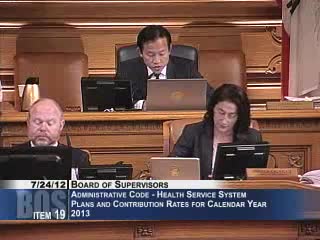
Board backs health‑service changes after Health Service Board recommends 'flex‑funded' Blue Shield plan
Summary
The Board approved amendments to city employee health‑plan administration that implement a flex‑funded approach for the Blue Shield option, accepting a calculated exposure to claims volatility while limiting immediate rate increases.
The San Francisco Board of Supervisors approved an ordinance amending city health‑service system plan administration after board members reviewed a Health Service Board recommendation to shift the Blue Shield plan from fully insured coverage to a flex‑funded arrangement.
Supervisor David Chiu summarized the changes and the financial trade-offs for supervisors: the city would move away from a fully insured Blue Shield contract because the insurance renewal rates had produced a projected 13.2 percent increase — roughly a $39 million cost increase — under the status quo. The Health Service Board and its actuaries recommended a flex‑funded option with a $5 million rate stabilization reserve to reduce immediate rate increases for employees and the employer.
Under the recommended path, employees’ share of the Blue Shield increase would shrink from a projected $20 million to about $2 million, and employer costs would fall from a projected $19 million to about $7 million in the near term. The board heard that a flex‑funded approach leaves the city exposed to a maximum modeled liability of up to $31 million (a “stop‑loss” kicks in above that level), though the actuarial analysis reported a 0.2 percent probability of reaching that worst‑case scenario. Officials said available reserve funds were approximately $24 million (a combination of designated reserves and other funding) and would not fully cover the modeled maximum exposure.
Supervisor Chiu and others described the move as a temporary, risk‑tolerant step to stabilize rates while city staff continue to pursue long‑term solutions to plan competitiveness and wellness strategies intended to reduce claims. Supervisor Jane Kim acknowledged the risks but said the actuarial work and the Health Service Board's deliberations made her comfortable supporting the change for now.
The board adopted the ordinance on a roll‑call vote (10 ayes). Members said the measure buys time for the city to convene labor and other partners on wellness and other reforms and noted the city’s stop‑loss policy limits the exposure above the modeled maximum.
Catherine Dodd of the Health Service Board was in the chamber to answer technical questions during the hearing; supervisors asked staff to continue monitoring claims and report back if experience differs materially from actuarial assumptions.