Get Full Government Meeting Transcripts, Videos, & Alerts Forever!
Get email alerts on the Procurement topic
No spam. Unsubscribe anytime.
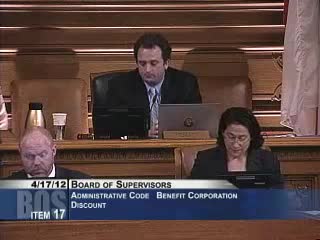
Supervisors advance pilot giving 4% bid preference to certified benefit corporations
Summary
The San Francisco Board of Supervisors approved on first reading an ordinance to grant a time-limited 4% bid discount to California-registered benefit corporations, with guardrails to avoid stacking with local-business preferences and to exclude subsidiaries. The pilot requires board action to renew after three years.
The San Francisco Board of Supervisors on Tuesday approved, on first reading, an ordinance that would give a 4% bid discount to California-registered benefit corporations competing for city contracts as part of a three‑year pilot program.
The measure, introduced by Board President David Chiu, is meant to support social‑enterprise models known as benefit corporations by offering modest contracting preferences while preserving existing local‑business and small‑business preferences. "Businesses that are doing well as they do good," Chiu said in introducing the ordinance.
Why it matters: Supporters said the program aims to encourage social entrepreneurship and direct some contracting preference toward firms that carry a stated public‑benefit purpose. Sponsors and committee members negotiated several limits to reduce unintended effects on local suppliers and on procurement integrity.
Key details and safeguards: The ordinance provides a 4% bid discount for benefit corporations registered under California law. The board record and committee discussion say the discount is not additive with Local Business Enterprise (LBE) discounts, and subsidiaries of larger companies are excluded from eligibility so that the preference applies only to true benefit corporations. The measure includes a sunset provision: the pilot expires in three years unless the board votes to extend it.
"I wanna make it clear, that these are contracting preferences that would come behind, any companies that are currently local business enterprises, non profits that are contractors, small businesses, or other regional businesses," Chiu said, describing the ordering of preferences adopted in committee deliberations.
A member of the Budget and Finance Committee summarized committee changes and listed the protections the committee secured, saying, "It would give a 4% bid discount generally to what is called a benefit corporation that is registered with the state of California... The LBE component, it is not additive... it exempts out from this bid discount any subsidiaries... and finally, there is a time limited component to this legislation such that in 3 years, the board has to act affirmatively to renew this program." (Committee remarks in the board record.)
Outcome and next steps: The ordinance passed its first reading on a roll‑call vote recorded as 10 ayes, 0 noes. Under the city's legislative process the ordinance will return for a second reading and final passage unless otherwise scheduled. The three‑year pilot requires affirmative board action to continue beyond that period.
The board did not record any amendments on the floor changing the discount percentage, the non‑additivity with LBE preferences, the subsidiary exclusion, or the three‑year sunset; those elements were discussed and described during committee remarks and by the sponsor. The board will consider the ordinance again at a subsequent meeting for final passage or additional amendment.