Get Full Government Meeting Transcripts, Videos, & Alerts Forever!
Get email alerts on the Small Business Regulation topic
No spam. Unsubscribe anytime.
Board advances overhaul of eating-and-drinking rules to first reading, reducing 13 business categories to 3
Summary
An ordinance to simplify the planning code’s controls on eating and drinking establishments — reducing 13 definitions to three categories (restaurant, restaurant-limited, bar) — was advanced to first reading after amendments. Supporters said the overhaul will help small businesses and neighborhoods adapt.
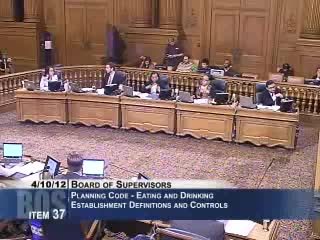
The Board of Supervisors advanced an ordinance on April 10 that overhauls the city’s planning-code controls for eating and drinking establishments, consolidating roughly 13 definitions into three categories: restaurant, restaurant-limited and bar. The measure passed to first reading after floor amendments and was supported unanimously by the board.
Supervisor Scott Wiener, the legislation’s sponsor, described the changes as overdue and said the code had become overly prescriptive, regulating trivial distinctions that impeded small businesses. "It simplifies the planning code in a comprehensive way by reducing the existing 13 different definitions for an eating or drinking establishment down to 3," Wiener said. He argued the reform would encourage small business creation, allow existing establishments to adapt, and maintain neighborhood-specific controls for formula retail and alcohol intensification where appropriate.
The ordinance includes neighborhood-specific provisions and a list of minor technical and clarifying amendments the sponsor distributed on the floor; one change would require conditional-use authorization for alcohol intensification in the Upper Market NCT and Castro districts. Supervisors Carmen Chu, Olague and Kim voiced support and described extensive outreach and coordination with the planning department, small business commission and neighborhood groups.
Why it matters: Supporters said the reform will make permitting more transparent and lower regulatory barriers for small and neighborhood-serving businesses while preserving protections for neighborhood character and alcohol controls.
What happens next: The ordinance was passed to first reading and will return for further committee and board consideration consistent with the city’s ordinance process.