Get Full Government Meeting Transcripts, Videos, & Alerts Forever!
Get email alerts on the Civil Liberties Counterterrorism topic
No spam. Unsubscribe anytime.
Board passes first reading of ordinance limiting city participation in federal counterterrorism activities
Summary
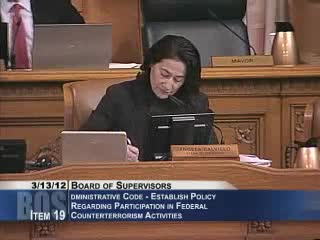
The Board of Supervisors approved on first reading an ordinance, as amended, to codify local limits and oversight on city law-enforcement participation in federal counterterrorism activities after debate over secrecy, oversight and civil liberties.
The San Francisco Board of Supervisors on March 13 approved on first reading an ordinance, as amended, that sets local limits and oversight requirements for city participation in federal counterterrorism activities, including arrangements with the FBI and joint terrorism task forces.
Supporters said the measure is intended to restore public trust after a secret 2007 memorandum of understanding between the city and the FBI came to light and to enshrine in law protections the city now says it follows in practice. “This legislation will make San Francisco more safe,” Supervisor Kim said during debate, arguing the ordinance would ensure intelligence gathering is based on a “clear criminal predicate” and create local oversight similar to other public-safety frameworks.
The ordinance was amended in committee and on the floor to remove a final section that would have urged the police chief to amend or terminate an existing MOU and to clarify that federal authorities control security clearances. The board also streamlined reporting requirements for the Office of Citizens’ Complaints as part of those amendments.
Proponents described a history of public testimony about aggressive counterterrorism practices and racial or religious profiling, and said codifying standards would protect civil liberties and reassure affected communities. President Chiu and several supervisors cited examples — including earlier Human Rights Commission and Police Commission hearings and a 2011 report endorsed by the board — as evidence that written law is needed in addition to internal police orders. “These are things that rise to the level where an ordinance is appropriate,” Supervisor Campos said.
Opponents, including Supervisor Wiener, said the department already has detailed general orders and police-commission oversight, and questioned whether codification in the municipal code was necessary. Wiener argued general orders and the police commission provide mechanisms to adopt and enforce operational standards without legislation and said he would vote against the ordinance.
On the roll call to adopt the ordinance as amended in first reading, the board recorded six ayes and five noes; the measure passed on first reading and will return for second reading and further legislative steps. The vote reflected a split in the board over whether codifying the rules into the administrative code is the right tool to guarantee long-term protections.
Supporters said the ordinance requires future memoranda of understanding involving intelligence activity to be submitted to the police commission for review and makes compliance with the department's general orders a condition of any future arrangement. Opponents said the same goals could be achieved by ensuring the police commission enforces existing policy and general orders.
The ordinance drew a broad coalition of community and civil rights organizations and prompted extended public comment during the board’s public safety committee hearings. The legislation’s author and backers said the measure is modeled in part on actions taken in other jurisdictions and responds to concerns raised in public testimony about surveillance and profiling.
The board did not adopt the ordinance in final form; further votes are required. Supporters said they expect the city attorney and staff to prepare the ordinance for the next calendar step and to provide the additional analysis requested during debate.