Get Full Government Meeting Transcripts, Videos, & Alerts Forever!
Get email alerts on the Americas Cup topic
No spam. Unsubscribe anytime.
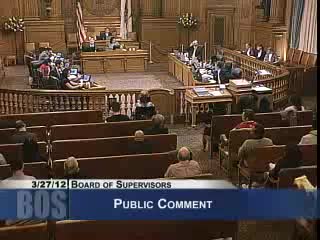
Board adopts amended America's Cup plan, shifts to port-led infrastructure and requires local-hire reporting
Summary
The Board of Supervisors voted unanimously to approve amended agreements for the America's Cup events, shifting from a long-term development model to port-delivered capital projects, requiring local-hire coverage on permanent construction and quarterly financial reporting tied to ACOC fundraising and an event surety.
The San Francisco Board of Supervisors on Tuesday approved an amended package of agreements to host the America's Cup, consolidating the city's role around short-term event delivery and port-led infrastructure work rather than a long-term development deal.
The 11-0 vote adopted the amendment of the whole and two companion resolutions that revise the city's earlier agreements with the America's Cup Event Authority (ACEO/ACOC) and refocus the program on staging near-shore races in 2012 and the full 2013 regatta season. Mike Martin, America's Cup project director in the Office of Economic and Workforce Development, told the board: "What's before you today is really a straightforward proposition. It's bringing the most venerable event in sailing to a 1 of a kind location in San Francisco Bay." (Mike Martin, America's Cup Project Director)
The amendment removes plans for long-term private development tied to the event and instead directs the Port of San Francisco to deliver a package of capital repairs and temporary facilities as public works projects. Brad Benson, Port special projects manager, described a roughly $8.5 million project to repair and re‑deck parts of Pier 30–32 (particularly Pier 30–32 deck repairs and H‑20 roadway work on Pier 32) and a broader set of port capital work the port estimates at about $22 million in total. "We think that this is about an $8,500,000 project at this point," Benson said of the Pier 30–32 repairs. (Brad Benson, Port Special Projects Manager)
Why it matters
City staff and event partners said the change reduces risk to the General Fund by retaining certain port sites for revenue use, limiting the city's exposure to long-term rent concessions, and financing port work through bond capacity and port capital funds instead of developer-funded reimbursement. Officials also said the event authority has committed to quarterly fundraising transfers to the city and to demonstrate $12 million in receipts by the end of the fiscal year; the amended agreement establishes a plan for the city to report back to the Budget and Finance Committee if ACOC fundraising shortfalls require further adjustments to the event plan.
Major provisions and safeguards
- Port capital delivery: Port staff will pursue a suite of public works projects (including pier deck repairs, marginal wharf repairs, shoreside power relocation and limited dredging). The port expects to finance much of the work with debt made possible by retaining long-term rent on several sites and by reallocating port funds. Benson told the board the port's bonding capacity would grow under the revised approach.
- Event schedule: The 2012 plan was condensed to one August event (five days) and a second event in October (coordinated with Fleet Week); the 2013 racing schedule remains the Louis Vuitton Challenger Series in July–August and the America's Cup final in September.
- Financial protections: The amendment sets parameters for insurance, indemnity and a security instrument (ACOC surety or bond) up to $32 million to protect the General Fund, and it requires quarterly reporting to the Board on ACOC fundraising, port infrastructure expenditures and city operating costs related to the events.
- Workforce and local hire: The workforce development plan was revised to require the city's local hire ordinance to apply to permanent infrastructure work associated with the project regardless of whether the port or the event authority delivers the work. Martin told the board the city and event authority negotiated to "apply the local hire ordinance under either approach." (Mike Martin)
Park and community concerns
The Golden Gate National Parks Conservancy and the National Park Service sought an explicit financial guarantee for potential damage or additional operating costs to Crissy Field and other national park lands. Martha Krupp, a Conservancy trustee, said parties had mutually agreed months earlier on a letter of credit from the event authority as a financial guarantee, but "just 2 weeks ago, we learned that the event authority's role in providing this guarantee and issuing a letter of credit was off the table. Instead, the city would be responsible for the operating costs and potential, damage and wear and tear associated with America's Cup events on national park lands." (Martha Krupp, Golden Gate National Parks Conservancy)
Several union and neighborhood representatives urged robust local-hire, prevailing wage and small-business inclusion. Dave Hill of ILWU Local 34 and Patrick Kim, secretary-treasurer of Local 75, told the board the maritime unions expect to work ports and event-related marine operations; community speakers asked for clearer plans to channel visitor spending into neighborhoods, boost minority- and women-owned business participation and expand youth and school programming tied to the event.
Public comment and outreach
More than two dozen public speakers addressed the board during the special order. Supporters argued the event would drive tourism, jobs and international exposure. Skeptical or cautious commentators pressed for stronger guarantees for Crissy Field, more specific workforce and small-business inclusion mechanisms, and explicit arrangements to ensure Fleet Week and other long-running civic events can coexist with America's Cup infrastructure.
Vote and next steps
The board approved the amendment of the whole and related resolutions on a roll-call vote of 11-0. The adopted motions require quarterly reports to Budget and Finance and the Comptroller, continued work with the ACOC on the security instrument and further engagement with the Park Service and Conservancy to clarify mitigation and funding mechanisms for park impacts. Staff said the approvals would allow permit amendments and construction planning to proceed on an accelerated timetable for 2012 and 2013 events.
"By putting forward these construction projects, we know that the Pier 27 cruise terminal project has already begun. So we've got that step forward," Martin said when asked about the compressed timeline. (Mike Martin)