Get Full Government Meeting Transcripts, Videos, & Alerts Forever!
Get email alerts on the Wireless Siting topic
No spam. Unsubscribe anytime.
Board conditions approval of Larkin St. cell facility on independent review of AT&T coverage data
Summary
After a contested appeal by neighbors over an AT&T proposal to install panel antennas inside a church steeple at 2041 Larkin St., the Board of Supervisors approved the conditional‑use authorization only after adding a condition requiring an independent evaluator (paid by AT&T) to verify the carrier’s underlying coverage and alternative‑site data.
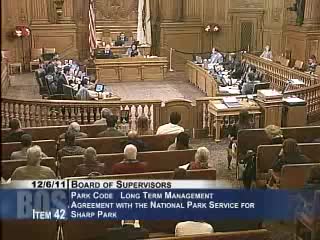
San Francisco supervisors voted Dec. 6 to approve a conditional‑use authorization allowing AT&T to place panel antennas inside the steeple of the Church of the Fellowship of All Peoples at 2041 Larkin St. — but only after adding a new condition requiring an independent technical review of AT&T’s coverage and alternatives analysis.
The decision followed a multi‑hour public hearing in which residents of Russian Hill mounted a detailed appeal, presenting two independent peer reviews that found AT&T’s submission lacked sufficient raw data to substantiate a significant gap in coverage or to show the proposed church location was the least‑intrusive alternative. Neighbors emphasized the site’s residential character and raised structural‑safety and security concerns about installing equipment in a largely vacant, century‑old church building.
AT&T and its engineers argued the project was a Preference‑1 location under city wireless siting guidelines (public/institutional structures), that the antennas would be screened inside the steeple and associated mechanical equipment would be enclosed on a second‑floor room out of public view, and that the carrier’s maps showed a capacity/coverage shortfall during peak usage periods. AT&T said the carrier’s consumer coverage maps differed from its network capacity analyses because the company must account for high‑demand periods and modern LTE capacity needs.
Planning staff and the Planning Commission recommended approval after reviewing AT&T’s materials and finding the project met city criteria for necessity and compatibility; the Planning Commission had approved the CU earlier.
Supervisor Scott Wiener proposed a compromise condition after hearing competing technical claims: the Board would approve the project only if an independent evaluator selected by the Planning Department (with input from the parties) and paid by AT&T could verify that AT&T’s submitted data and conclusions were accurate. That evaluator must be a California‑licensed professional engineer, and AT&T must provide all requested data and may request a confidentiality agreement. The Board voted 8–3 to adopt Wiener’s condition and approve the CU as amended.
What this means: The conditional‑use authorization can proceed only after the independent technical evaluation confirms AT&T’s coverage and alternatives analysis. If the evaluator finds AT&T’s data do not substantiate a coverage gap or least‑intrusive analysis, the condition gives the Board and the Planning Department evidence‑based grounds to require further changes or to revisit the authorization.