Get Full Government Meeting Transcripts, Videos, & Alerts Forever!
Get email alerts on the Telecommunications Cell Sites topic
No spam. Unsubscribe anytime.
Board affirms planning commission approval for AT&T wireless facility at 199 Leland Avenue over neighborhood objections
Summary
After a public hearing with translators and nearly three hours of testimony, the Board of Supervisors affirmed the Planning Commission ecision to allow AT&T to install nine rooftop panel antennas and six equipment cabinets at 199 Leland Avenue, voting 10—or and 1 gainst.
The San Francisco Board of Supervisors on Tuesday affirmed a Planning Commission decision authorizing a conditional use permit for AT&T to install a wireless telecommunications facility at 199 Leland Avenue, approving the motion 10—or, 1 gainst.
Project details: AT&T proposed nine new panel antennas on the roof of a three-story mixed-use building, concealed in faux chimney stacks, and six equipment cabinets in the building garage. Planning staff characterized the site as a preferred location type under the city's wireless siting policy for mixed-use, high-density neighborhoods. The Department of Public Health reviewed the proposal and projected that radio-frequency emissions would be well under FCC exposure limits (projected to be less than 9% of the FCC limit in the planning report).
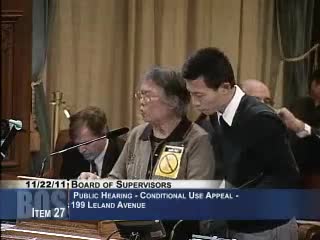
Public hearing and community concerns: The item drew an extended public hearing with many neighborhood residents testifying in Cantonese and Mandarin; translation services were provided. Appellants and multiple residents objected that AT&T had not proven the facility was necessary for neighborhood coverage, and they urged the board to require AT&T to seek nonresidential alternatives (for example, along Highway 101/280 or at a Recology/transfer site). Residents also raised safety concerns about proposed lead-acid backup batteries and said installing equipment in the garage could reduce parking and impede mobility for seniors and people with disabilities who live in the building. Appellants submitted a neighborhood survey of 110 AT&T customers reporting 87% rated in-building voice service as "good or better" and 77% rated in-building data service as "good or better."
AT&T and independent engineering evidence: AT&T presented a detailed engineering report and a third-party field study by the firm Hammitt and Edison. AT&T nd its engineers explained the technical concept of "noise" (interference on capacity-constrained cellular frequencies) and said signal-bar indicators on phones are an imperfect measure of service quality because they do not capture signal-to-noise degradation that can make connections unreliable during periods of high demand.
Hammitt and Edison conducted measurements over three days at 31 locations across Visitacion Valley. Their findings, summarized for the board, indicated most measurement points had adequate capacity overnight but that during daytime (11 a.m.) and evening (8 p.m.) hours many measurement sites were at or approaching capacity. The firm's report concluded those capacity constraints would be eased by installing a properly sited facility to serve the valley.
Planning commission and staff: The Planning Commission unanimously approved the conditional use authorization on Oct. 6, 2011, finding the site was a preferred location for WTS, that the installation would be minimally visible from the public right of way, and that the Department of Public Health's analysis showed RF emissions within FCC limits.
Board action: After hearing presentations from the appellant, from planning staff, and from AT&T, Supervisor Cohen moved to affirm the Planning Commission's decision (filed as item 28 on the board agenda); Supervisor Farrell seconded. On the roll call the board recorded 10 ayes and 1 no (Supervisor Mar). The board thus affirmed the commission's conditional use authorization; related motions to disapprove or to direct additional findings (items 29 and 30) were tabled during the vote.
Next steps and commitments: AT&T and board members agreed to facilitate language access for any post-installation Department of Public Health measurements requested by residents. The Board noted it lacks authority under federal law to deny a WTS permit based solely on RF-health concerns if the facility complies with FCC standards; the Department of Public Health will continue to monitor emissions and can take on-site measurements on request.
Residents who opposed the project said they would use the additional administrative and political levers available to them; appellant counsel asked for a continuance to Dec. 13 to obtain expert analysis but AT&T declined to agree to that request. The board's affirmation of the Planning Commission ends the appeal at the board level; future legal or administrative remedies remain available under law.
Provenance: The record includes the Planning Commission's Oct. 6, 2011 conditional-use approval, appellants' exhibits including a customer survey and a critique of AT&T's engineering report, AT&T's technical submissions, and Hammitt & Edison field measurements presented at the hearing.