Get Full Government Meeting Transcripts, Videos, & Alerts Forever!
Get email alerts on the Public Assembly Policing topic
No spam. Unsubscribe anytime.
Public, supervisors clash over SFPD tactics after raids at Occupy SF; board members call for dialogue
Summary
Public testimony at the Board of Supervisors’ meeting focused on Occupy San Francisco and its policing after apparent overnight raids; demonstrators and many supervisors called for restraint, clearer city coordination and protection of protesters’ First Amendment rights while others warned about sanitation and public-safety risks.
Dozens of members of the public used the Board of Supervisors’ general-comment period on Tuesday to describe police raids on Occupy SF and to urge the board to protect demonstrators’ free-speech rights and safety. Several supervisors also addressed the demonstrations earlier in the meeting during the mayor’s policy session.
Nut graf: The meeting recorded substantial public testimony alleging aggressive police and DPW tactics in early-morning actions at Occupy SF encampments. Speakers — including participants who said they were injured or had property removed — pressed supervisors to adopt a clear stance protecting assembly rights and to demand restraint and transparency from the San Francisco Police Department.
Allegations and public testimony: Several speakers described being physically knocked down, held in vans and having tents, food and medical supplies taken by law enforcement and department-of-public-works crews during an early-morning operation. One witness told the board she was “threatened, terrorized, and physically assaulted by a member of the San Francisco Police Department for merely holding up a sign.” Others described heavy police presence in riot gear, use of acceleration by vehicles near people and what they characterized as unnecessary force.
Many speakers said the response amounted to intimidation that undermined peaceful protest. “This is illegal, un-American, and unacceptable,” a speaker said of the Sunday-night operation. Multiple public speakers and several supervisors demanded the city provide a clear, public policy describing when and how police will act at protests, and asked for an explicit statement protecting the right of assembly.
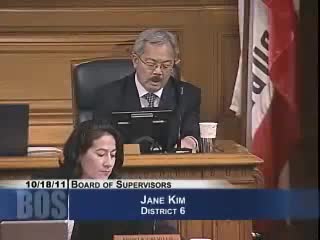
Supervisors’ responses and city statements: Board members acknowledged both the right to assemble and the city’s interest in public safety. Supervisor Jane Kim said she had met with protesters, observed the demonstration and relayed that the police chief had asked that demonstrators avoid cooking on open flames and not set up tents, tarps or wooden pallets in ways that create fire hazards. Kim said SFPD told her that if demonstrators stay within those parameters, police were not expected to take enforcement action at Justin Herman Plaza. Supervisor John Avalos urged flexibility in city response and emphasized the need to protect the right to peaceful assembly.
The mayor and police had repeatedly said publicly that the city would try to strike a balance between permitting peaceful protest and enforcing laws on public obstruction, safety and sanitation; the mayor reiterated that approach in his remarks. Other supervisors expressed concern about the cost and logistics of policing a large, continuing encampment and urged coordination among police, Department of Public Health, Recreation and Parks, and other departments.
Community calls for transparency: Speakers and supervisors asked the board to demand a public accounting of commands and decision-making that led to the early-morning operations, to require advance notice to the public and demonstrators of enforcement plans, and to seek written protocols from the involved departments. Protesters urged the board to adopt a supportive resolution or other public action.
Ending: The volume and tone of public testimony — including multiple first-hand accounts of alleged police force — left the board with visible calls for oversight and clarity. Several supervisors committed to continuing conversations with protesters and with the chief to seek a path that protects both the right to assemble and public safety.