Get Full Government Meeting Transcripts, Videos, & Alerts Forever!
Get email alerts on the Municipal Finance Pensions topic
No spam. Unsubscribe anytime.
Mayor Lee tells supervisors pension, retiree-health costs remain challenging; highlights Healthy San Francisco outcomes
Summary
Mayor Ed Lee briefed the San Francisco Board of Supervisors on pension projections and retiree health liabilities, defended recent workforce controls and summarized independent findings on Healthy San Francisco, while saying city officials must balance First Amendment protections with public-safety and sanitation responses to Occupy SF.
Mayor Ed Lee told the San Francisco Board of Supervisors on Tuesday that the city faces continuing pressure from rising pension and retiree health-care costs, urged careful control of salary growth and defended tighter hiring approvals as a near-term strategy to manage budgets.
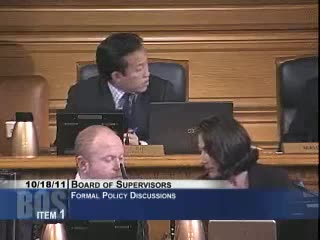
Lee opened the board’s formal policy discussion by thanking supervisors for placing pension reform on the ballot and stressing that changes to pensions themselves must be approved by voters under the city charter. “Changes to the pension system can only be made by San Francisco voters in our city charter,” Lee said. He said controlling salary growth and a stricter review of vacancy filings are tools the city can use immediately to contain future pension liabilities.
Nut graf: The mayor framed the city’s finances around two long-term obligations — pension benefits and retiree health care — and described administrative steps the executive branch is taking now to limit future cost growth. He also summarized an independent evaluation of Healthy San Francisco and addressed how the city is balancing public-safety and free-speech concerns raised by Occupy SF.
On pensions and retiree health, Lee cited estimates reported to the board that projected pension costs could exceed roughly $700 million by 2014–15 and said the city’s unfunded retiree-health liability is on the order of $4.4 billion. He noted Proposition C (on the November ballot) is intended to reduce the long-term pension burden, and that, if adopted, it would also require active employees to begin contributing to retiree health care and allow the city to negotiate higher contributions than the minimum. “Proposition C will create a balance on the Health Services Board which we expect will lead to more responsible plan designs that will slow the rate of costs for the near future,” Lee said.
Lee emphasized the city’s current operational response: a “strict approval process for the filing and the filling of all vacant positions that impact our general fund,” applying scrutiny to cost, necessity and public-safety implications. “We’ve learned in the past that the ‘hard freeze’ doesn’t work, but through diligence in the job approval process, we can begin trimming the size of our workforce to match our revenues,” he told the board.
On local health-care delivery, Lee reviewed findings from an independent two-year evaluation of Healthy San Francisco, the city’s locally created access program for uninsured adults. He said program data show 75–85 percent of participants have at least one primary-care visit and almost half receive recommended preventive services; utilization for diabetics and asthmatics is comparable with insured Medicaid populations. “Participants show steadily declining emergency room use over time,” Lee said, summarizing the evaluation’s conclusion that connecting patients to medical homes is associated with fewer nonemergency visits to San Francisco General Hospital and fewer potentially avoidable hospitalizations among uninsured adults.
Lee cautioned that expanding primary- and preventive-care use may raise short-term costs even while it reduces emergency utilization over time and that federal health-care changes will require adjustments. He told the board the city’s general fund support for Healthy San Francisco was “relatively stable” from FY 2009–10 to FY 2010–11 and that additional costs during that period were covered by federal funds, employer spending requirements and participant fees.
On Occupy SF and public assembly, Lee said the city supports the “spirit” of the Occupy movement and the right to peaceful protest, but added that tents, fires and structures that block public ways and create hazards raise safety and sanitation concerns. “We stand with you in expressing anger and frustration,” he said, but added: “That’s not the same as pitching tents and lighting fires in public places and parks that are meant for use by everyone in our city.” Lee said the city has spent “over $100,000 accommodating protests,” and described steps — extra trash and recycling receptacles, portable toilets on request, and direct communications between police and demonstrators — intended to preserve both speech rights and public safety.
Board reaction and context: Supervisors asked about the fiscal details and operational implications of Lee’s remarks during the odd-district policy session; questions addressed changes to city bargaining strategy, the ongoing role of the Health Services Board, and how the city will respond to long-running demonstrations. Several supervisors also used their time to press the mayor on Occupy SF logistics, public-health concerns and preserving protesters’ First Amendment rights.
Ending: Lee closed by urging continued partnership between the mayor’s office and the board on budget and labor decisions and requested further collaboration as the city adjusts programs in light of federal health-care reform and local fiscal constraints.