Get Full Government Meeting Transcripts, Videos, & Alerts Forever!
Get email alerts on the Public Transit topic
No spam. Unsubscribe anytime.
Board urges SFMTA and BART to renegotiate feeder-payment method, adopts amended resolution
Summary
The San Francisco Board of Supervisors adopted an amended resolution urging the San Francisco Municipal Transportation Agency and BART to negotiate a feeder agreement methodology linking payments to measured transfer trips and to seek retroactive payment for FY2010; SFMTA staff warned written conditions could hinder negotiations.
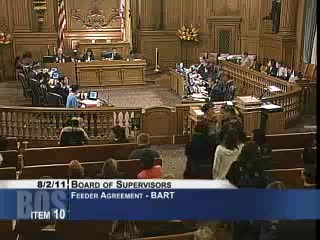
The San Francisco Board of Supervisors on Aug. 2 adopted an amended resolution urging the San Francisco Municipal Transportation Agency (SFMTA) and the Bay Area Rapid Transit District (BART) to renegotiate the methodology used to calculate feeder payments so those payments are tied to the number of actual transfer trips between Muni and BART, and to consider a retroactive payment for fiscal year 2010. The resolution passed on a roll-call vote after Supervisors discussed amendments to the draft.
Supporters of the amendment said the existing feeder agreement does not provide a clear nexus between transfer trips and the compensation BART pays SFMTA. “The feeder agreement that we have before us does not make the nexus between trips, while the Fast Pass agreement does,” said Supervisor Campos, who moved the amendments. Campos said the Board intends to condition approval of future feeder agreements on inclusion of retroactive-payment provisions unless the agencies reach an acceptable alternative.
SFMTA representative Ms. Bose cautioned supervisors that putting the retroactivity requirement in writing could constrain negotiations with BART and make it harder to reach a favorable long-term agreement. “I think BART at this point is fully aware of the concerns,” Bose said, “but I don’t know if we can [get retroactive payment]. I think it will be difficult.” She said requiring retroactivity as a written precondition might limit the agency’s ability to negotiate the best outcome for FY2011 and beyond.
Supervisor Chu and other members said they supported urging renegotiation of the methodology but expressed concern about conditioning future approvals on retroactivity without knowing whether that condition would produce a better overall deal. Chu offered a second-degree amendment to remove a further-resolve clause that would have conditioned future approvals on retroactive payment; supervisors voted to remove the clause and proceeded with the resolution as amended.
After the amendment was adopted, the board voted by roll call to adopt the resolution as amended. The clerk announced there were 11 ayes and the resolution was adopted as amended.
The resolution directs SFMTA to present a renegotiated pass/reimbursement agreement with BART for FY2011–2012 at the same time as related Muni fare agreements and urges the agencies to develop a methodology that provides a clear nexus between transfer trips and feeder payments. It also urges the agencies to pursue retroactive payments for FY2010 if the new methodology shows amounts are owed.
SFMTA staff said they will try to pursue retroactivity but cautioned supervisors that the agency lacks unilateral authority over BART and that firm written conditions could reduce bargaining flexibility. Supervisors framed the resolution as an advisory action urging the agencies to pursue an accounting and negotiation approach that protects SFMTA’s financial interests.