Get Full Government Meeting Transcripts, Videos, & Alerts Forever!
Get email alerts on the Telecoms Cell Sites topic
No spam. Unsubscribe anytime.
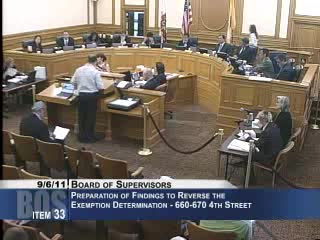
Board Affirms Planning Department on 4th Street AT&T Antenna; Appellant Says Roof Deck Was Omitted from Review
Summary
The Board of Supervisors upheld the Planning Department's finding that AT&T's proposed antennas at 660–670 Fourth Street are categorically exempt from CEQA, rejecting an appeal from a resident who said rooftop outdoor space was not considered in RF exposure calculations.
The San Francisco Board of Supervisors on Tuesday affirmed the Planning Department's determination that the proposed AT&T telecommunications installation at 660–670 Fourth Street is categorically exempt from environmental review under CEQA, rejecting an appeal by a building resident who said the company and its consultants failed to account for a privately used roof deck.
The ruling came after more than three hours of testimony from the appellant, Planning Department staff, the project sponsor's representatives and technical consultants. Supervisor Kim moved to affirm the Planning Department determination and to table related items for findings; the motion, seconded by Supervisor Ellsburn, passed on a roll call vote of 11–0.
The appellant argued the application omitted or misrepresented the existence and proximity of a frequently used rooftop deck and that site plans and the RF exposure report did not include measurements that would show the antennas' public-exposure perimeter reached that deck. He told the board his family uses the deck several times a week and said, "If you wouldn't allow these antennas to be located on or next to a school yard or public playground, you shouldn't allow them to be located on the roof of 660–670 Fourth Street." He asked the board to require further environmental review.
Planning Department legislative affairs manager Anne Marie Rogers told the board the question before the supervisors was narrowly legal: whether the department had properly considered environmental impacts as required by CEQA. Rogers and senior environmental planner Noni Turrell said the department concluded the proposal complied with FCC public-exposure guidelines and therefore satisfied CEQA. Rogers explained the antennas are highly directional and that the planning department's RF maps show the public-exposure zones largely fall off the property. She said the Department of Public Health (DPH) reviewed the projections and had no concern about public areas on the roof outside the delineated exclusion zones.
AT&T's counsel, Amanda Monchamp of Holland & Knight, and the project's RF engineer, Bill Hammett of Hammitt & Edison, presented site measurements and engineering analysis to support the conditional use authorization and the CEQA exemption. Hammett said the antennas are directional, that the exclusion bubble shown in the project materials focuses energy straight ahead of the antenna and that "the FCC's exposure limits are easily met at the deck or any other place on the roof outside those little yellow areas." He also said DP H performs confirmatory field measurements after a site goes on air and that San Francisco requires post‑installation readings within 10 days.
Hammett described the procedure for workers who might need to access roof areas that exceed certain worker exposure thresholds: zones would be signed, barricaded and workers would be notified; work can occur if the antenna is turned down or temporarily powered off.
The appellant disputed AT&T's distances and engineering assumptions and said he had personally measured a stairway and deck access point that he said placed the usable walkway inside the projected public-exposure perimeter. AT&T representatives and their engineer said the most relevant measurement is the directional exposure contour, not a simple radius, and that their on-site tape measure showed a 56-foot distance from the antennas to the deck area cited by the appellant. The project sponsor also provided evidence of community outreach and wrote that AT&T intends to decommission two smaller sites as part of network consolidation.
After questions from supervisors about who turns off antennas for worker access, timing of DP H field measurements and whether the antenna boxes would be accessible, Planning and the AT&T team said DP H conducts pre‑ and post‑installation reviews and will perform periodic monitoring. Planning staff and the engineer said carriers have an ongoing obligation to comply with FCC limits and that the city can require corrective measures if post‑installation readings exceed predictions.
The board's vote affirms the Planning Department's CEQA determination for the Fourth Street site and keeps the conditional use approval process intact. The appellants may pursue other legal remedies outside the Board's CEQA review process.
The board did not order removal of the antennas; it upheld the Department's categorical exemption finding and denied the appeal. Planning staff said DPH will perform post‑installation confirmation measurements and that field monitoring is required under city procedures.