Get Full Government Meeting Transcripts, Videos, & Alerts Forever!
Get email alerts on the Mayoral Qna topic
No spam. Unsubscribe anytime.
Mayor addresses supervisors on affordable housing, transit goals and a revived commercial‑corridor cleanup plan
Summary
In a formal question‑and‑answer session the mayor outlined five strategies to expand affordable housing in higher‑cost neighborhoods, described priorities for Muni and regional transit projects, and proposed a commercial corridors apprenticeship program to restore street cleaning and graffiti abatement.
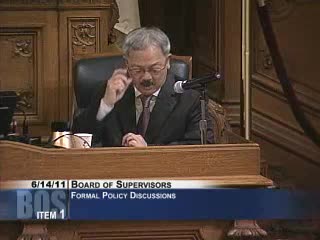
At a June 14 session set aside for supervisors to question the mayor, the mayor responded to a set of topics that ranged from affordable housing in expensive neighborhoods to challenges at the Municipal Transportation Agency and neighborhood cleanliness programs.
Affordable housing: five priorities When asked how to expand affordable housing in higher‑priced neighborhoods such as the Richmond District, the mayor said the city can pursue five broad strategies: advocate for state and federal matching funds (including HOME and CDBG funding), use local funds to acquire existing rental housing and make it permanently affordable, ensure the inclusionary housing ordinance incentivizes on‑site affordable units, prioritize underused publicly owned sites for affordable development, and explore an acquisition revolving loan fund to allow rapid purchases of sites when they come on the market. The mayor said the Mayor’s Office of Housing and Redevelopment has historically used redevelopment and surplus public sites but is now constrained by reduced local, state and federal funds.
St. Luke’s hospital viability On the future of St. Luke’s Hospital, the mayor said his office’s proposed development agreement with CPMC seeks to ensure the campus’s long‑term viability by requiring elements of the St. Luke’s Blue Ribbon Panel recommendations. The mayor said the development agreement identifies orthopedics as a specialty service for the St. Luke’s campus, and asks CPMC to establish centers of excellence in senior and community health and to reflect charity‑care and Medi‑Cal obligations in service contributions at the campus.
Transit priorities and safety Addressing the Municipal Transportation Agency, the mayor said MTA should focus on three priorities for 2011: sustain momentum on major capital projects (including high‑speed rail connections, the Transbay Terminal, Central Subway and rapid bus corridors), improve on‑time performance and safety benchmarks (he cited a voter‑mandated 85 percent on‑time target for Muni), and encourage alternatives such as walking, bicycling and electric vehicles. The mayor emphasized the need to reduce pedestrian injuries and fatalities — he cited roughly 800 annual pedestrian injuries and 22 fatalities — and urged expedited implementation of bike lanes, regional bike sharing and installation of 100 electric‑vehicle chargers.
Commercial corridors and cleanup plan Responding to a question about commercial corridor cleanliness and sidewalk upkeep, the mayor said his budget restores a portion of the Community Corridors Partnership Training Program. The restored funding will pay a nonprofit to hire 20–30 workers trained and managed by the Department of Public Works, in partnership with Laborers Local 261, to deploy on selected five‑block commercial corridors, work up to 32 hours per week, provide merchant and resident education about litter responsibilities and support local hire goals.
Ending The mayor said he looked forward to working with supervisors on the budget and pledged continued engagement on housing, transit and neighborhood cleanliness initiatives.