Get Full Government Meeting Transcripts, Videos, & Alerts Forever!
Get email alerts on the Land Use Noise Union Street topic
No spam. Unsubscribe anytime.
Board upholds Planning Department exemption for Brickyard patio despite neighbors' noise concerns
Summary
The Board of Supervisors affirmed the Planning Department's categorical exemption for a new outdoor patio at 1787 Union Street, rejecting appellants' request for a full CEQA review. Neighbors testified about repeated noise problems; the Planning Department cited Entertainment Commission sound readings.
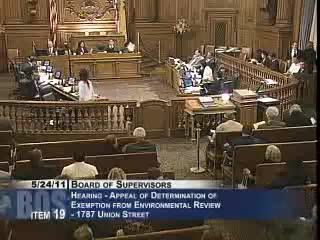
The San Francisco Board of Supervisors on May 24 upheld the Planning Department's determination that the project at 1787 Union Street (the Brickyard) is categorically exempt from environmental review, rejecting appellants' request to require a CEQA document analyzing projected noise impacts.
Appellants and many nearby residents argued the proposed outdoor patio and the restaurant's open bifold doors will project amplified crowd noise into adjacent homes and businesses. Gloria Smith, attorney for the appellants, said the Planning Department had acknowledged potential noise impacts and nevertheless treated the matter as a categorical exemption. "Because the city has admitted the project has noise impacts," Smith told the board, "you must return this project back to the planning department to prepare a CEQA document that analyzes the impacts and circulate that for public review."
Neighbors presented photographs, on-the-ground sound meter readings and personal recordings that they said showed loud, recurring noise events when the front doors were open and the patio was occupied; several said noise reached living-room windows less than 75 feet away. Megan Shashile, who lives directly across Union Street, submitted a recording and a contemporaneous sound reading and described an auditorium-like patio that projects sound upward and across the street.
Planning Department staff and the city's Entertainment Commission told the board that onsite sound measurements did not show violations of the city's noise ordinance. Kelly Ander, Director of Current Planning, said the City's transportation noise map indicates existing 24-hour ambient noise (Ldn) in the 70–74 dBA range along that block of Union Street, and that Entertainment Commission inspector readings (including a test on the previous Saturday with doors open) showed levels consistent with those ambient readings. "These tests show the noise levels to be compliant with the city's noise ordinance and along the range of the ambient noise levels," Ander told the board. The department recommended denial of the appeal and adoption of the categorical exemption.
The Brickyard's operators described the venue as a neighborhood restaurant and said they had invested in sound mitigation, security and managerial controls. Darren Matt, operating manager, and co-owners said typical weekday attendance averages 30–60 patrons and that they had accepted planning-commission conditions including limiting the number of open doors and closing the patio at night.
Supervisor Farrell, who represented the district in which the property sits, moved that the board approve item 20 (affirming the Planning Department's exemption) and table items 21 and 22 (the reversal motion and findings). He also asked the Entertainment Commission and Police Department to perform three random post-opening tests and report back to his office; he said that if noise ordinance violations occur the city will enforce them. The board approved the motion by roll call: the clerk recorded 11 ayes and no noes on the motion to approve item 20 and table items 21 and 22.
Appellants had argued that the commission's conditions of approval amount to mitigation measures and that courts have rejected "mitigated categorical exemptions." Planning staff countered that the planning commission used discretionary authority to add conditions beyond CEQA, but that the department's CEQA determination remains valid because the tests showed no substantial permanent increase in ambient noise from the project.
The decision ends the environmental-appeal phase at the Board level; appellants may pursue other administrative remedies. The board's vote leaves the planning commission's conditions in place, including limits on open doors and hours of patio operation. Implementation and enforcement will now be handled by planning, the Entertainment Commission and the Police Department, which several supervisors asked to monitor.