Get Full Government Meeting Transcripts, Videos, & Alerts Forever!
Get email alerts on the Payroll Tax Stock Options topic
No spam. Unsubscribe anytime.
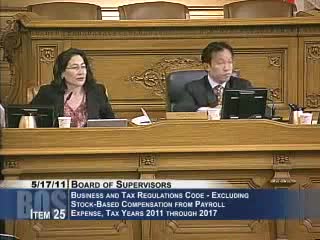
Board advances payroll tax exclusion for stock-based compensation after heated debate
Summary
The San Francisco Board of Supervisors voted to pass in first reading an ordinance excluding certain payroll taxes attributable to stock‑based compensation, a narrowly tailored measure aimed at pre‑IPO companies. The vote followed hours of debate over whether to pursue targeted relief now or delay for a comprehensive tax overhaul.
The San Francisco Board of Supervisors voted in favor of an ordinance in the first reading that allows limited exclusions from payroll expense tax for payroll attributable to stock‑based compensation, a change proponents said targets a small number of pre‑IPO companies. The measure passed after an extended debate and a failed motion to continue the item.
Sponsor Supervisor MacRaeamy said the ordinance is “a stock option tax exemption” designed to address a narrow set of firms and to provide data for any later, broader tax reform. She described the proposal as a “toe in the water” that would allow the city to measure the fiscal effects before undertaking comprehensive overhaul. Supervisor Jane Kim, who spoke in support, noted the city’s unique tax structure: “We are the only county in the state of California to levy a payroll tax,” and said the exclusion is narrow and would affect a small number of firms.
Opponents pressed for a broader, unified approach rather than piecemeal exemptions. Supervisor Farrell moved to continue the item four weeks to consider the stock‑option proposals together; that motion failed on a roll call vote. After consideration of a technical amendment offered by the sponsor and accepted by the City Attorney’s office, the board voted on the ordinance as amended.
On the motion as amended the roll call produced seven ayes and three noes; the ordinance passed the first reading. The board recorded objections and amendments during debate and asked staff and the controller’s office to monitor fiscal impacts and report back as the exclusion is implemented.
Board members said they expect follow‑up work from the controller, the treasurer and the tax collector to monitor revenue impacts and to inform any future, broader business tax reform effort. The board did not adopt any additional, sweeping changes at this meeting and preserved the option to revisit the issue with more comprehensive proposals later.
Ending: The measure will return for a required second reading as part of the board’s legislative process. Staff said the controller’s and the treasurer’s offices will track and report any revenue impacts and demographic information about firms that take the exclusion.