Get Full Government Meeting Transcripts, Videos, & Alerts Forever!
Get email alerts on the Land Use Housing topic
No spam. Unsubscribe anytime.
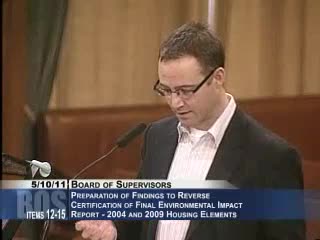
Board certifies housing-element EIR over neighborhood objections; 8-3 vote
Summary
Board of Supervisors certified the final Environmental Impact Report for the 2004 and 2009 housing elements after a public hearing that drew dozens of neighborhood speakers and exposed sharp disagreement over last‑minute policy changes, water‑supply projections and the EIR's alternatives analysis.
Board of Supervisors certified the final environmental impact report (EIR) for the city's 2004 and 2009 housing elements after a lengthy public hearing and debate, advancing the city's housing-policy process despite objections from neighborhood groups and plaintiffs who have litigated earlier versions of the plan.
The board's certification, passed by an 8'to'3 roll‑call vote, came after the planning department and outside appellants exchanged technical arguments for several hours. The planning department maintained the EIR analyzed reasonably foreseeable development, considered the environmental effects on transit and other public services, and included an adequate range of alternatives. Appellants said the document omitted new, substantive policy changes inserted after the public review period and did not evaluate feasible reduced‑growth alternatives or a recently updated water supply projection.
The hearing drew dozens of residents and neighborhood‑association representatives who testified that language added late in the process would expand where denser housing is encouraged, reduce protections for single‑family and low‑scale residential areas and intensify demand on city infrastructure. Appellant counsel Cathy Devincenzi said the last‑minute changes provide a policy basis to undermine density limits in RH‑1 and RH‑2 districts and that the EIR's alternatives analysis was inadequate.
Planning Department staff, including senior planner Sarah Jones and project manager Sarah Dennis Phillips, responded that the EIR used standard ‘‘soft‑site’’ capacity analysis to locate where housing could reasonably occur under existing zoning and that the document did not use the RHNA allocation as a baseline for environmental impacts. Jessica Range, the EIR's environmental coordinator, said the EIR identifies a potentially significant cumulative transit impact by the 2025 horizon year and that for most other topics the analysis found impacts could be mitigated or were less than significant.
Appellants pointed to a memo from the San Francisco Public Utilities Commission reporting a new projection of a 7.4 million gallon per day shortfall related to upstream flow requirements; they argued that constituted new information requiring further environmental review. Planning staff said they consulted the PUC and concluded the EIR's findings remained valid. Opponents urged the board to remand the draft to planning for further analysis; supporters including housing advocates urged the board to certify the EIR to allow housing policy work to proceed.
Supervisor Jane Kim moved to certify the final EIR and table related reversal motions; Supervisor Scott Wiener seconded. After debate, the board voted to certify the EIR by 8 ayes to 3 noes.
The certification advances the housing element process but does not itself rezone property or change development standards. Those land‑use changes would require separate legislative actions and additional environmental review if and when the city proposes rezoning.
What happens next: certification allows the planning department and the board to continue work on the housing element and on any implementing zoning changes. Opponents signaled they may pursue further legal review.