Get Full Government Meeting Transcripts, Videos, & Alerts Forever!
Get email alerts on the Land Use Ceqa topic
No spam. Unsubscribe anytime.
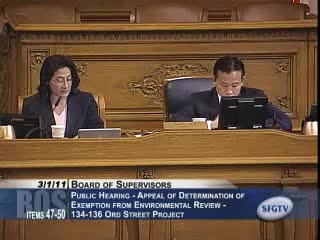
Board affirms planning department on Ord Street CEQA exemption after extended hearing
Summary
After a multi-hour hearing with expert testimony and neighborhood speakers, the Board of Supervisors affirmed the Planning Department's determination that the proposed project at 134'136 Ord Street is categorically exempt from environmental review under CEQA.
San Francisco ' The Board of Supervisors affirmed the Planning Department's categorical-exemption determination for a proposed new building at 134'136 Ord Street, rejecting an appeal that argued the agency had failed to conduct required environmental review for the project.
The case drew a lengthy hearing that included neighborhood residents, preservation professionals and the project sponsor's representatives. Appellants argued that the Planning Department relied on an environmental review prepared for a different, earlier project (an alteration of 136 Ord) and failed to analyze potential impacts on nearby recognized historic resources. The Planning Department and the project sponsor said the department had performed the needed review and that the record supported issuance of the categorical exemption.
Appellant counsel Steve Williams told the board the department "simply failed to conduct the required environmental review for the project. Period." The planning staff said it had evaluated the cottage at 136 Ord in 2008 and concluded it was not a historic resource; the staff said that conclusion and related analysis carried over to the later application and that any clarifying file notation was administrative.
Architect Joseph Butler, retained by the appellants, testified the proposed three-story infill could cause "a substantial adverse change" to the adjacent recognized historic resource at 140 Ord Street, and that the department's report did not analyze visual or setting impacts on that resource.
Brett Gladstone, counsel for the project sponsor, said the planning record reflected review of the new building and that appellants were seeking to use historic-preservation rules to unwind a planning-commission compromise on front-yard setbacks. Sponsor John Maroney said he had made concessions, including reducing height and increasing front setback, and sought permission to build a second dwelling and off-street parking on his lot.
Supervisor Mark Wiener moved to affirm the Planning Department's determination; the motion passed on roll call 11-0. In announcing the vote, Wiener noted the record contained a Planning Department analysis of the historic-preservation issues and said the procedural concerns raised by appellants did not warrant sending the matter back.
The board's action affirms the Planning Department's categorical exemption determination; the case remains subject to any subsequent legal remedies that parties may pursue outside the legislative record.
Key points from the hearing: - Appellants argued the initial environmental review used the wrong project description and failed to analyze off-site impacts on nearby historic resources. - Planning staff said a 2008 historic-resource evaluation for 136 Ord concluded the cottage was not a historic resource; staff said the later change in project scope did not change the underlying exemption determination. - The board accepted the Planning Department's conclusion and affirmed the exemption by an 11-0 vote.