Get Full Government Meeting Transcripts, Videos, & Alerts Forever!
Get email alerts on the Transbay Eminent Domain topic
No spam. Unsubscribe anytime.
Board adopts resolutions of necessity for multiple Transbay parcels after public hearings
Summary
The San Francisco Board of Supervisors on Dec. 7 adopted a series of resolutions of necessity authorizing the acquisition by eminent domain of parcels and easements needed to build the Phase 1 Transbay Transit Center and related bus ramps after a multi‑hour public hearing.
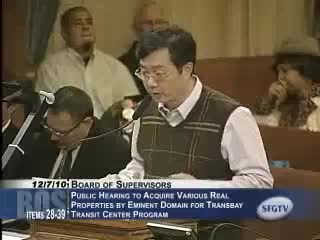
The San Francisco Board of Supervisors on Dec. 7 adopted a set of resolutions of necessity to acquire multiple parcels and easements by eminent domain for the Transbay Transit Center program, following public hearings in which property owners and their attorneys raised objections and the Transbay Joint Powers Authority (TJPA) staff described project needs.
The board convened as a committee of the whole for a public hearing on 12 separate resolutions covering properties and easement interests associated with the Phase 1 Transbay Transit Center construction and bus ramps. The properties named in the resolutions included multiple addresses on Natoma Street and Howard Street and related parking easements; the staff said the parcels are necessary for bus ramp alignment, foundations and other elements of the intermodal facility.
TJPA staff presented the project purpose: a new intermodal station with an above-grade park, a subsequent rail extension for Caltrain and high-speed rail, and a mixed-use neighborhood. Staff and the project consultant described the project footprint, the ramp geometry and why the identified parcels are required for safe construction and operation. The TJPA noted it has already reached negotiated settlements for 13 other properties required for the project and that these cases represent properties for which negotiation did not produce an agreement within the project schedule.
Property owners and counsel of record appeared to register objections and outline concerns. Owners of 564–568 Howard; of 60 Tehama; and of portions of 85 Natoma and related parking easements addressed the board. Counsel for a Howard Street owner argued that (1) the TJPA had not negotiated in good faith; (2) the project materials provided to owners were inconsistent over time; and (3) an immediate-possession timetable (seeking possession within 90 days of filing) was impermissible given prior representations and the property owner’s investment activity. Another owner said the project had disrupted leasing and refinancing prospects for years and alleged misleading outreach by project representatives.
TJPA responded that the acquisitions were disclosed in the environmental impact report adopted by the board in February 2004, that the agency had pursued negotiations for several years (first offers dated in 2007 for some properties), and that the agency is seeking only the interests necessary for Project construction. TJPA acknowledged that design details continue to be finalized in the design phase but said the acquisitions are needed to keep the project on schedule and avoid construction-cost escalation.
After the public comment and rebuttal, the board voted separately on each resolution. The clerk recorded roll-call votes for each parcel resolution; most of the resolutions were approved by large margins (a typical result recorded in the minutes was 11 ayes). The board recorded findings required under eminent‑domain law, including that the acquisitions are necessary for the public interest and that the TJPA had made offers of just compensation as required by state law. The board also adopted associated CEQA and general-plan consistency findings tied to the previously certified environmental review and applicable planning-code sections.
TJPA counsel and staff noted that property valuation and compensation are not decided at the hearing and instead will be settled through negotiation, jury trial or further proceedings under state eminent‑domain law. The resolutions authorize the agency and city to commence condemnation proceedings where necessary; those proceedings will include separate processes to determine fair-market compensation or reach negotiated settlements.
Speakers (attributed): Emilio Cruz — TJPA program manager and consultant team representative, presented project overview and justification for acquisitions. Andrew Schwartz — Counsel to the Transbay Joint Powers Authority (available in chamber for legal questions). Herman H. Fitzgerald — Attorney representing owners of 564 Howard (filed objection letter dated Nov. 23); summarized objections and legal concerns including the 90-day immediate-possession request and the scope of the taking. Claude and Nina Gruen — Property owners, offered facts about development work and interactions with planning staff. Virgil Chen — Owner/operator representative for 568 Howard, described difficulty maintaining tenants amid project uncertainty. Thomas Byrne — Attorney for owner of 60 Tehama (Peter Byrne), said TJPA provided inconsistent project diagrams and urged postponement or further fact development. Patrick McNerney (Martin Building Company) — Owner interest at 85 Natoma and 580 Howard; said his firms supported the project in the abstract but described specific impacts to parking, rents and operations and requested mitigation or accelerated acquisition for affected buildings.
Authorities cited during the hearing: California Environmental Quality Act (CEQA) findings per Administrative Code Chapter 31, and city planning-code consistency findings with the general plan and planning-code section 101; the items also relied on the Transbay EIR certified by the board in 2004 and subsequent addenda.
Actions taken (each resolution was acted on separately by roll call): the board adopted resolutions of necessity authorizing acquisition by eminent domain of specified fee and easement interests for parcels at 85 Natoma Street (multiple unit identifiers), 60 Tehama Street, 564 Howard Street, 568 Howard Street, and related parking easements, and adopted CEQA and general-plan consistency findings in support of the acquisitions. The clerk recorded roll calls for each resolution; the majority of votes recorded in the minutes were in favor (many recorded as 11 ayes). The board’s formal adoption permits the agencies to commence condemnation actions where negotiations have not resolved ownership interests and to seek possession and compensation under state law.
Next steps: TJPA will continue negotiations where possible and, where not resolved, will file condemnation complaints and proceed under eminent‑domain law to establish possession and compensation. Property valuation and final compensation remain subject to negotiation or judicial determination; the board’s action resolves the public‑interest and necessity determinations required by state law to proceed with condemnation if needed.
Clarifying details: the parcel acquisitions were disclosed in the project EIR certified in Feb. 2004 but remained unresolved by negotiated settlement in several late‑stage cases; TJPA’s first offers for several Howard Street parcels date to 2007; TJPA staff contends delaying action would threaten construction schedule and raise costs. Owners asserted changes in project graphics and shifting staff responses complicated property owners’ ability to plan and invest.
Searchable tags: Transbay, eminent domain, TJPA, 85 Natoma, 564 Howard, 568 Howard, 60 Tehama, CEQA, eminent_domain
Ending: With the board’s adoption of the resolutions, TJPA is authorized to pursue eminent-domain steps where negotiations fail; separate procedures will determine compensation. The project team said the acquisitions are necessary to avoid schedule slippage on a regional transportation facility that the authority projects will serve tens of millions of annual passengers once rail extension work is complete.