Get Full Government Meeting Transcripts, Videos, & Alerts Forever!
Get email alerts on the Local Hiring topic
No spam. Unsubscribe anytime.
Board approves first-reading ordinance to require mandatory local hiring on public construction projects
Summary
The San Francisco Board of Supervisors on Dec. 7 passed on first reading an ordinance authored by Supervisor John Avalos to require mandatory local hiring on most publicly funded construction projects, beginning at a 20% local-hire floor and escalating to 50% over time.
The San Francisco Board of Supervisors on Dec. 7 passed on first reading an ordinance authored by Supervisor John Avalos creating a mandatory local-hire program for publicly funded construction projects, setting a floor of 20% local participation to escalate over seven years to 50% and adding trade-by-trade requirements and apprenticeship targets.
The ordinance, introduced by Supervisor John Avalos, replaces the existing system of “good-faith” goals with mandated participation levels, establishes a pipeline and retention compliance framework, clarifies subcontractor reporting, and adds apprenticeship and disadvantaged-worker provisions. Supporters said the measure is designed to direct a larger portion of jobs created by the city’s capital program to San Francisco residents; opponents raised concerns about implementation, timing and potential impacts on specific contracts.
Supervisor Avalos framed the ordinance as a citywide workforce and economic-justice tool tied to an anticipated $27–30 billion in public capital projects over the next decade. The ordinance includes: a phased mandatory participation schedule beginning at 20%; an escalating target to 50% over several years; by-trade mandates and apprentice-hour requirements; “pipeline and retention compliance” mechanisms that allow conditional waivers in specified circumstances; revised penalties language replacing the term “liquidated damages” with “penalties”; and expanded record-keeping and reporting requirements to compare worker demographics on projects with the local qualified labor pool.
Supporters in the chamber included supervisors Marr, Maxwell, Campos, Dufty and Marr, as well as representatives from the building trades, neighborhood organizations and foundations. Labor and community groups on record during the meeting included the Carpenters Union and the Laborers Local leadership; supervisors and staff thanked dozens of community partners, consultants and city staff who helped shape the ordinance. Deputy City Attorney John White summarized technical changes made on the floor, including the start level (20%) and conforming edits to apprentice, referral-source, and reporting provisions.
Several supervisors spoke in favor, describing the measure as a “sea change” from voluntary goals to enforceable requirements and citing environmental co‑benefits from reduced commuting and local economic multipliers. Supervisor Maxwel and others described local hiring as a way to grow the middle class and reduce long commutes. Some supporters noted the measure had been negotiated with labor, developers and city departments and that the controller’s report underpinned key assumptions.
Opposition and concerns voiced during debate included implementation complexity, the possibility that some work may require specialized trade workers not currently available locally, and the effect on specific ongoing or planned contracts. Supervisors asked for safeguards including off-ramps for specialized trades, credit for sponsor-apprentice programs and direct-entry apprenticeship agreements administered by the Office of Economic and Workforce Development (OEWD). The deputy city attorney described new “pipeline and retention compliance” clauses that allow conditional waivers where contractors demonstrate certain recruitment or apprenticeship actions.
As amended on the floor, the ordinance includes: a lower initial mandatory level (20% instead of a higher floor), a by-trade apprenticeship requirement that at least 50% of project apprentice hours within each trade be performed by local residents (with a minimum 25% of those apprentice hours to be performed by disadvantaged workers), and a broadened definition of disadvantaged worker to add participation in vocational English-as-a-second-language programs. The package of amendments — including an amendment of the whole offered by Supervisor Avalos and seconded by Supervisor McRamey — was adopted before final roll-call.
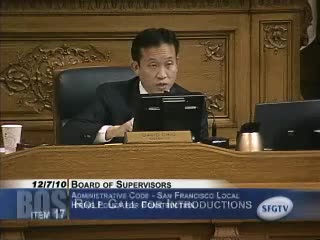
On the roll call for Item 17 (the ordinance as amended), the board recorded eight ayes and three no votes; the clerk announced the ordinance had passed on first reading. The ordinance will return for further hearings and adoption steps required under the municipal process.
The board’s action followed months of committee work, community hearings and technical drafting with city departments. Proponents said the measure is intended to be the nation’s strongest local-hire law for construction, with phased implementation and technical compliance pathways. Opponents asked for careful implementation to avoid unintended disruption of project schedules and to ensure compliance procedures are administrable. The ordinance text, conforming amendments and staff reports remain the primary legal references for next steps.
Implementation and next steps include further rulemaking and administration by OEWD and related departments, reporting requirements to the board, and the possibility of future technical amendments to address operational questions raised by contractors, trade groups and city departments.
Supervisor Avalos said the measure responds to longstanding community demands for economic opportunity and local jobs; supporters said the ordinance will create pathways into construction trades for residents of neighborhoods with high unemployment. Critics stressed the need for clear compliance rules, protections for existing collective-bargaining hiring halls, and attention to cash-flow and scheduling issues on major capital projects.
Affected stakeholders listed during the hearing included community-based job-training programs, apprenticeship programs, the San Francisco Public Utilities Commission on major infrastructure projects and multiple labor organizations. The ordinance requires city departments and contractors to produce local-hire plans for large projects, and it mandates annual reporting to the board comparing project workforce demographics to the qualified labor pool.
Speakers (attributed): Supervisor John Avalos — Sponsor and primary proponent; presented the ordinance and floor amendments. Deputy City Attorney John White — Summarized technical conforming changes and compliance language. Guillermo Rodriguez — Director, CityBuild (mentioned as program partner). Ed Harrington — General Manager, San Francisco Public Utilities Commission (mentioned in testimony and thanked by sponsor). Supervisor David Campos, Supervisor Bevan Dufty, Supervisor Eric Mar, Supervisor Maxwell — vocal supporters during floor debate. Bob Alvarado; Mike Brown; Vince Courtney; Ramon Hernandez; Manny Flores; other labor representatives — cited as participating stakeholders and supporters.
Authorities referenced in the hearing and ordinance text: the San Francisco Administrative Code provisions being amended (local hiring policy and related subsections as cited in the ordinance), apprenticeship program rules referenced in ordinance subsection text, and administrative code reporting requirements. (The ordinance text and conforming table language are the operative legal documents; no external state statute was cited as creating a new requirement.)
Clarifying details: the ordinance establishes phased mandatory percentages (start 20% → up to 50% over seven years); a by-trade apprentice goal requiring at least 50% of apprentice hours to be by local residents and at least 25% of apprentice hours to be performed by disadvantaged workers; “disadvantaged worker” expanded to include vocational ESL participants; contractors and subcontractors at all tiers are required to report and comply; penalties language uses “penalties” (replacing “liquidated damages” wording); pipeline and retention compliance mechanisms include sponsoring apprentices, credit for hiring on noncovered projects, and direct-entry agreements with apprenticeship programs.
Community relevance: the policy targets San Francisco neighborhoods with high unemployment (Bayview-Hunters Point, Visitacion Valley, OMI, Excelsior, Tenderloin, Chinatown) and is tied to the city’s capital program and major projects that generate construction work.
Searchable tags: local hiring, workforce development, apprenticeships, San Francisco, construction, Supervisor John Avalos, OEWD
Ending: The ordinance passed its first reading and will return to the board for additional legislative steps; implementation details and OEWD administration will determine how quickly the new requirements affect hiring on major city-funded construction projects.