Get Full Government Meeting Transcripts, Videos, & Alerts Forever!
Get email alerts on the Public Infrastructure Assessments topic
No spam. Unsubscribe anytime.
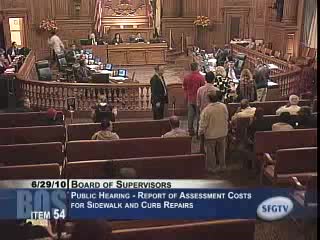
Supervisors hear complaints on sidewalk and blight assessments; DPW to continue review
Summary
Property owners disputed Department of Public Works assessments for sidewalk repairs and blight abatement at a June Board of Supervisors hearing; DPW removed six properties from its delinquent blight list and the board continued remaining sidewalk assessment matters to July 27 for further review.
The San Francisco Board of Supervisors held a public hearing on sidewalk-repair assessments and blighted-property liens on Tuesday, June 29, 2010, and heard more than a dozen property owners who disputed invoices and the city’s process for placing unpaid repair costs on property tax rolls.
Department of Public Works staff told the board the sidewalk inspection and repair program inspected roughly 50 city blocks between April 2009 and February 2010, issued 2,173 notices, repaired 716 properties and recovered $516,664.63 from about 600 paying property owners. The department said it is submitting 109 properties with outstanding invoices totaling about $114,965 to be placed as assessments on the tax rolls.
Property owners said many repairs resulted from utility work (they cited PG&E repeatedly), prior city repairs, foreclosures that were not disclosed to buyers, and recurring vandalism or graffiti. Several owners described repeated cleanups that were immediately re-tagged, small charges that became large assessments, and the strain of payments on small businesses and seniors.
Why it matters: Placing unpaid sidewalk and blight charges on a property tax roll can create liens and additional costs for owners and for subsequent buyers. Several speakers said the department’s notifications did not travel with transactions and that repeated damage by third parties, including utilities, should not fall solely to property owners.
Board members pressed DPW staff on whether the city can coordinate with utilities or apply hardship/instalment arrangements. DPW said the code holds fronting property owners responsible for sidewalk maintenance; staff said they will research incidents involving utilities and may advise owners to file claims when appropriate. DPW also said it sometimes holds work in abeyance while investigating responsibility and will attempt to coordinate with City Attorney staff and other agencies.
After the hearing, DPW reported it had resolved individual cases at the meeting and removed six properties from the blight list, reducing the list from 49 to 43. The board formally adopted the revised blight list as amended after those removals.
Action and next steps: Supervisors voted without objection to continue the remaining sidewalk assessment matters (item 55) to a follow-up hearing on July 27, 2010, so the department can pursue individual resolutions and pursue discussions with utilities where appropriate. The Board adopted the amended blight assessment report (originally 49 properties, reduced by six during the hearing) by roll call vote (11 ayes). DPW staff said they would continue one-on-one follow-ups with owners and consider installment arrangements where hardship was shown.
Property owners and supervisors called for clearer notice practices for buyers, more documentation when repairs are caused by utilities, and a system to avoid repeatedly charging owners who are victims of recurring graffiti. Several supervisors asked DPW to coordinate with the City Attorney and with utility oversight teams to explore systemic fixes.
The hearing record will be updated with the amended blight list and the sidewalk assessment matter will return to the board July 27 for further action or finalization.