Get Full Government Meeting Transcripts, Videos, & Alerts Forever!
Get email alerts on the Mental Health Aot topic
No spam. Unsubscribe anytime.
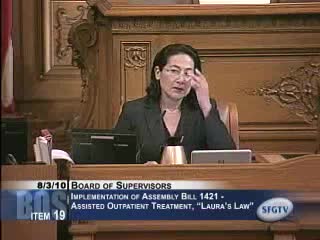
Board debates assisted outpatient treatment ("Laura's Law"), refers measure back to committee
Summary
Supervisors debated implementing Assembly Bill 1421 (Laura's Law), which would allow assisted outpatient treatment (AOT) for a small group of people with severe mental illness. After extended public and board discussion, the item was referred back to committee for more work.
Supervisor Michela Alioto‑Pier introduced a resolution asking the Board of Supervisors to authorize implementation of assisted outpatient treatment under Assembly Bill 1421 (commonly called Laura's Law) and to request a controller analysis of local mental‑health funding.
The proposal would create a court‑ordered assisted outpatient treatment (AOT) structure for a narrow subset of people with severe mental illness who have repeatedly failed to engage in voluntary services. Proponents described AOT as community‑based, multidisciplinary care that can include medication support, housing assistance, vocational help and case management; opponents and the Department of Public Health questioned whether Laura's Law would actually improve treatment access in San Francisco and whether funding and statutory safeguards are adequate.
Why this matters: Supporters said AOT could prevent repeated hospitalizations, homelessness and criminalization of people with severe psychotic illness, citing examples from New York (Kendra's Law) and small local pilots. Opponents — including the city's director of health — said California's legal framework restricts the ability to require medication and that San Francisco lacks the additional funding to implement the law without displacing existing voluntary services.
During the hearing, Dr. Mitch Katz, Director of Health, told the board he did not believe Laura's Law is "effective treatment," saying the law does not increase the city's ability to require medication for psychotic illness and that public‑health ethics discourage restricting rights unless an efficacious treatment is available. He said the proposal would create a "22‑step" process involving significant court and administrative costs and could draw funds away from voluntary services.
Sponsor Supervisor Michela Alioto‑Pier and family members of people with serious mental illness spoke in favor, saying the law targets fewer than 1 percent of the city's mentally ill population and would provide families a legal route to hearings and AOT services before people enter the criminal justice system. She said some clinicians and national organizations support AOT as a tool for very ill patients who repeatedly relapse when off medication.
Board members raised several recurring concerns: whether implementation would reduce access to voluntary services; whether Prop 63 (the Mental Health Services Act) funds could be used for any required elements; whether existing local programs (for example the behavioral health court) already provide similar services for people involved with the criminal justice system; and the potential administrative cost for court hearings and public‑defender representation. Dr. Katz said Prop 63 can be used for the voluntary portions of a program but does not provide new dedicated dollars for mandatory services.
Public commenters and clinicians offered mixed evidence, citing small (and sometimes uncontrolled) pilots in Los Angeles, Nevada County and New York, and arguing both that AOT reduced hospital days and that trials with proper controls show benefits are attributable to enhanced services rather than involuntary status.
Action and next steps: Supervisor Alioto‑Pier moved to refer the resolution back to committee for further work; the motion was seconded and, "without objection," the Board referred the item back to committee for more analysis and drafting. No final policy change or ordinance was adopted at this meeting.
The board directed additional committee review to clarify funding sources, the role of the Department of Public Health and the Health Commission, statutory requirements (including provisions for Riese/Reis hearings and involuntary hospitalization procedures), and whether local conservatorship reforms could address some of the same cases. The referral preserves the status quo while staff and supervisors collect more data and discuss statutory and fiscal details.
Ending: The referral signals continued debate rather than a policy decision; board members asked staff and the sponsor to return with more detailed legal, fiscal and implementation analysis before considering adoption.