Get Full Government Meeting Transcripts, Videos, & Alerts Forever!
Get email alerts on the Alcohol Fee topic
No spam. Unsubscribe anytime.
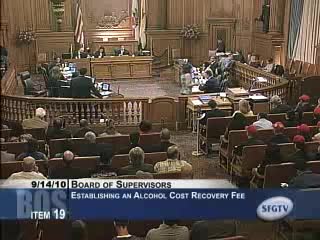
Board advances fee on alcohol wholesalers to fund alcohol-related services; first reading passes
Summary
The San Francisco Board of Supervisors advanced an ordinance in its first reading to impose a fee on alcoholic beverage wholesalers to recover part of the city’s alcohol‑attributable costs, adopting amendments to close purchase loopholes and index the fee to inflation.
The San Francisco Board of Supervisors advanced an ordinance in its first reading that would impose a fee on alcoholic beverage wholesalers to recover part of the city’s alcohol‑attributable health and emergency costs.
Supervisor John Avalos, the ordinance’s sponsor, said the measure is intended to help maintain treatment and public‑health services that “help us carry out our mission of keeping our sidewalks safe” and to shift some of the costs of repeated emergency care for severe alcoholism to alcohol distributors. Avalos cited a nexus study estimating about $17,700,000 in annual alcohol‑attributable costs and said the fee would collect up to 90 percent of that amount.
The ordinance sets per‑gallon rates Avalos outlined for wholesalers: 35 cents per gallon of beer, $1.00 per gallon of wine and $3.20 per gallon for distilled spirits, which he said would translate to roughly 3–5 cents per drink. Avalos also described several amendments the board accepted, including a provision to capture purchases by “warehouse” retailers that buy outside the city for resale inside San Francisco, an indexing mechanism tied to the consumer price index, and a biannual review mechanism to reduce the fee if collections exceed the target.
Why it matters: Backers tied the fee to continuing prevention, treatment, and emergency services for residents with severe alcohol problems — programs they said the city cannot sustainably fund from existing budget sources alone. Opponents warned of legal and economic risks and urged the board to weigh expense‑side savings and alternatives before imposing a broadly applied fee.
What the board debated and changed
Supporters: Avalos and several colleagues said the fee was the product of a year‑long process that included a controller’s office economic impact estimate. Supervisor Mark Mercarimi described one amendment to protect small sellers: a quarterly exclusion allowing payers to exclude the first $1,000 of fee liability in a quarter if their total liability for that quarter is below $1,000.
Opposition and legal concerns: Supervisor Ross Ellsberg said he admired the sponsor’s effort but raised two objections: that the city has not exhausted expense‑side options and that the city attorney’s office had warned the ordinance might be legally vulnerable. Ellsberg said, “Odds are this ordinance is illegal. We’re gonna spend north of a million dollars to defend this, and more likely than not, we’re gonna lose.” He also argued that a fee traditionally ties payment to a service received, and that most consumers who would pay the wholesale assessment would not directly receive a discrete city service in return.
Amendments accepted: The board accepted sponsor Avalos’s package of amendments to (a) close a potential loophole for large retailers that buy outside the city and resell inside it; (b) index the fee to the consumer price index; and (c) require a biannual review to reduce the per‑gallon charge if collections exceed the nexus target. Supervisor Mercarimi’s amendment establishing a quarterly exclusion for small payers was also adopted.
Recusal: Supervisor Alioto Pier recused herself from the matter because she holds an ABC wholesale license. The board moved and accepted the recusal without objection.
Formal action and next steps
The ordinance was passed on first reading at the Board meeting. The roll‑call tally on the first reading recorded seven ayes and three noes (recorded in the transcript as 7–3). The ordinance will return for subsequent readings and final passage consistent with the city’s ordinance process.
What the record does and does not show
The documents referenced at the hearing include a nexus study cited by the sponsor and an economic impact memo from the Controller’s Office that the sponsor said estimated a limited retail impact (the sponsor quoted a Controller estimate of less than a 1 percent decline in consumer spending and roughly 50 jobs affected citywide). The exact text of the ordinance and formal legal analyses were in the Planning/City Attorney packet; the board’s acceptance of amendments means the measure will be returned for final reading and a formal vote that will include the revised language.
Context note
Supporters framed the fee as one piece of the city’s response to alcohol‑related public health and public‑safety costs; opponents emphasized legal risk and the question of whether fees must more closely mirror a direct service or benefit to those who pay them.