Get Full Government Meeting Transcripts, Videos, & Alerts Forever!
Get email alerts on the Parks Fees topic
No spam. Unsubscribe anytime.
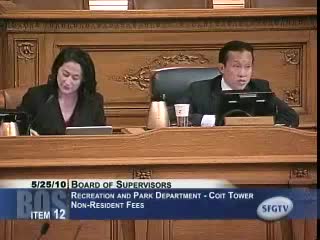
Board advances nonresident admission fee for Botanical Garden amid heated budget debate; ordinance passes first reading as amended
Summary
The Board of Supervisors voted to pass an ordinance in first reading establishing a non‑San Francisco resident admission fee for the Botanical Garden, adopting amendments linking the fee’s expiration to new tax revenue and adding reporting requirements; the vote was 8–3 on first reading.
The San Francisco Board of Supervisors advanced an ordinance on Tuesday to impose a nonresident admission fee at the Botanical Garden, a move the budget chair said is intended to help close a large shortfall in the Recreation and Parks department budget.
Supervisor David Avalos, the board’s budget chair, introduced the ordinance and told colleagues the department faces a deep budget gap; he said the nonresident fee is one of several revenue options to avoid deeper cuts to recreation, parks and social services. “We are now in a situation where gardeners across the city are ... forced to do impossible tasks of covering more ground,” Avalos said, citing staffing strains at several parks.
The ordinance, originating from the Budget and Finance Subcommittee, was amended during debate. Supervisor Avalos added findings tying the fee to the Department of Recreation and Parks’ budget shortfall and proposed an amendment stipulating that the authority to collect the nonresident fee would “expire by operation of law within 90 days of the effective date of the new tax” if the city later receives revenue from a new tax that can be used for garden operations. A separate amendment requiring biannual reporting on revenues, usage and expenditures for the fee was also adopted.
Why it matters: The change creates a new admission charge for non‑San Francisco residents at a public facility that has previously been free to all visitors. Supporters said the fee is a necessary stopgap to avoid layoffs and program cuts; opponents said it risks privatizing access to a public resource and could be a first step toward broader resident fees.
Board debate and votes
Supervisor Avalos said he was reluctant but felt compelled to support the fee because of a projected $483 million shortfall across city budgets and a need to find roughly $12.5 million in the Recreation and Parks budget. “I am not terribly pleased about having to vote in favor of this measure, but I think it's one thing that we can do to help our overall budget deficit,” Avalos said.
Opponents, including Supervisor Mar and Supervisor Marr, argued the Botanical Garden should remain free and warned the nonresident fee could presage further fees and reduced public access. Supervisor Mar said he would oppose the fee on principle and encouraged membership drives and other fundraising instead of a new user charge.
Several supervisors and witnesses noted labor and staffing impacts. Rec and Park representatives and union speakers had warned that without new revenue the department faces layoffs and reduced services; supporters of the fee said it would help shield gardeners and frontline staff from cuts.
Amendments adopted
- Link to new tax revenue: Avalos’ amendment (as clarified on controller advice) states that if the department receives revenue from a new tax that can be used for operating and maintenance costs at the Botanical Garden, the authority to collect the nonresident fee will expire within 90 days of the effective date of that new tax. - Reporting requirement: A separate amendment requires the Recreation and Parks Department to provide regular reports (biennial/biannual reporting was adopted) detailing gross revenues, capital expenditures and other data related to collection and use of fee revenue.
Final procedural outcome
After amendments, the ordinance was passed in the first reading as amended by roll call (8 ayes, 3 noes). The board adopted certain amendments without objection and voted on the ordinance as amended; the clerk recorded 8 ayes and 3 no votes on first reading. The item will return for second reading and final passage at a later meeting.
Context and next steps
Supporters framed the fee as a temporary, targeted revenue source tied to a specific departmental shortfall and paired it with a sunset/trigger tied to future new tax revenue. Opponents said the measure risks creating a precedent for charging for access to public green spaces and urged other revenue strategies, including progressive tax measures.
If adopted on second reading, the ordinance will change Recreation and Parks policy for the Botanical Garden and require the department to collect and report fee revenue as specified. The board also encouraged the Botanical Garden Society and other community partners to increase membership and philanthropic support as a complementary strategy.