Get Full Government Meeting Transcripts, Videos, & Alerts Forever!
Get email alerts on the City Health Budget topic
No spam. Unsubscribe anytime.
San Francisco holds marathon public hearing as Health Department proposes deep cuts to mental‑health, outpatient services
Summary
The San Francisco Board of Supervisors held a state‑law hearing on June 15 after the Department of Public Health proposed sweeping reductions affecting outpatient mental‑health, substance‑use and community case‑management programs.
The San Francisco Board of Supervisors held a state‑law hearing on June 15 after the Department of Public Health (DPH) proposed sweeping reductions affecting outpatient mental‑health, substance‑use and community case‑management programs.
DPH Director Dr. Mitch Katz told the board the department had worked to minimize damage while closing an unprecedented shortfall, saying, “we recognize the city’s budget crisis,” and that staff “had to make difficult choices” to fit programs into available general‑fund dollars. Katz said DPH reduced its general‑fund request by roughly $135 million when assembling the mayor’s balanced package.
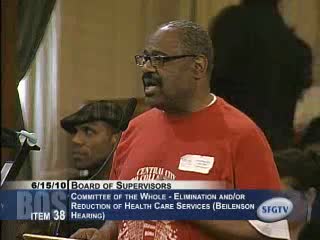
The hearing — a so‑called Buillenson process required when a health department proposes eliminating or sharply reducing services for indigent care — ran for hours and featured more than a hundred public speakers: clients and relatives, senior‑care providers, psychiatrists and clinic directors, and nonprofit leaders. Service providers said proposed cuts would force closure of critical programs for the city’s most vulnerable residents and ultimately increase costs through more emergency‑room visits, hospitalizations, arrests and homelessness.
At least three lead providers described targeted DPH reductions that would eliminate hundreds of treatment slots. Dale Milfey of the National Alliance on Mental Illness said, “the city that knows how is balancing its budget on the backs of the mentally ill.” Citywide community‑case‑management leaders, who run intensive programs for the most acute clients, warned that proposed reductions of roughly 38 percent to some citywide programs would remove access to care for high‑risk people whom “no one else will serve.” Dr. Emily Baldwin, an assistant professor of psychiatry, told supervisors that cutting 400 intensive case‑management slots could add “$60 million a year” in higher downstream costs, in her estimate, because untreated patients return to costly hospital and jail stays.
Clinicians and hospital staff described knock‑on effects on inpatient psychiatric units. San Francisco General Hospital psychiatry staff and union members warned that converting an acute inpatient ward to a lower‑staffed unit would create safety and capacity problems when community slots are reduced.
Several nonprofit leaders and program directors pressed the board for more-targeted alternatives to across‑the‑board cuts: prioritizing high‑acuity programs, restoring revenue‑generating services, and pursuing administrative savings elsewhere in the city budget. Family Service Agency executives said their agencies leverage roughly $1.20 in federal funding for every city dollar and that sudden local cuts would eliminate large parts of outpatient safety‑net capacity.
DPH, responding to questions from supervisors, stressed the department’s effort to preserve as many services as possible. Katz said DPH had increased grant and administrative savings to shield programs but conceded “these are all services that we do value” and that, if additional general‑fund dollars were found, programs would be restored.
The hearing did not conclude with a board vote; the Buillenson hearing is a public‑comment and information step that boards use to satisfy state notice and to record community input before taking any formal appropriation or program‑cut decisions.
What’s next: Supervisors and the mayor’s budget office will continue negotiations; several supervisors asked staff for alternative revenue and additional savings options before final budget votes. Service providers asked the board to pursue alternatives to deep outpatient cuts and to search for targeted restores before the July budget deadline.