Get Full Government Meeting Transcripts, Videos, & Alerts Forever!
Get email alerts on the Planning Ceqa topic
No spam. Unsubscribe anytime.
Board orders environmental review for 424 Francisco Street after appeal over six-space garage
Summary
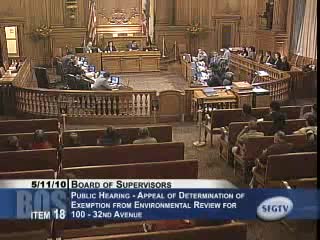
The San Francisco Board of Supervisors voted in May 2010 to reverse the Planning Department's categorical exemption for a proposed six-space garage at 424 Francisco Street and directed staff to prepare findings supporting environmental review.
The San Francisco Board of Supervisors voted in May 2010 to reverse the Planning Department's categorical exemption for a proposed six-space garage at 424 Francisco Street and directed the clerk to prepare findings supporting an environmental review. The action follows a lengthy appeal from neighborhood groups and preservation advocates who argued the project may cause cumulative traffic impacts, alter neighborhood character and harm a historic resource.
Appellants including Chinatown Community Development Center and Telegraph Hill Dwellers argued the proposal's small, incremental changes should not be judged in isolation. "When you look at all these combined effects, the cumulative impacts should lead to the reasonable conclusion that there is a significant cumulative effect with respect to the addition of parking spaces within that geographic area," said Omar Kalimbas, housing attorney with the Asian Law Caucus, citing an internal survey of Department of Building Inspection permits and an estimate of hundreds of additional parking spaces added in the neighborhood over recent years.
Why it matters: The board applied the CEQA "fair argument" standard for categorical exemptions, which requires an environmental impact report if substantial evidence supports a fair argument that the project may have a significant environmental effect. Appellants said that history of Ellis Act evictions and the pattern of garage insertions in North Beach justify further review; the Planning Department said the six-space proposal by itself does not rise to significance and that historic features of the building would be preserved.
What the board did: President David Chiu moved to table the motion that would have affirmed the Planning Department's exemption and to approve motions reversing the exemption and directing the clerk to prepare findings. The motion was seconded and carried, with the final roll call recorded as seven ayes and three noes. The board's action requires preparation of written findings and triggers further environmental review procedures.
Arguments for review: Appellants presented a cumulative-impact line of argument based on a DBI permit search covering several years. Malcolm Young of Chinatown Community Development Center said the group found roughly 67 garage-related permits within a one-mile radius over about five-and-a-half years, which they estimated represented about 273 new parking spaces; when narrowed to North Beach alone the group estimated dozens of added spaces and projected roughly 234 additional spaces over a ten-year period.
Appellants also submitted expert opinion challenging the Planning Department's preservation analysis. "There may be alternatives and less intrusive solutions, and the best way to figure that out is through an environmental review," counsel for the appellants said, referencing an architectural-historian critique on the project's effect on the building's character-defining features.
Planning Department response: Tara Sullivan, representing the Planning Department, told the board that staff treated 424 Francisco Street as a historic resource throughout their review and that preservation staff concluded the insertion of a garage opening and limited lifting of the building (up to about two feet in the project description) would not materially impair the building's ability to convey significance. Sullivan said the department's environmental division determined the small amount of additional parking would not cause traffic hazards or degrade nearby intersections sufficiently to require further CEQA analysis.
Project sponsor and preservation consultant: Vincent Marsh, a planner and architectural historian who reviewed the plans for the owner, described alternatives considered and said the structure could be rehabilitated while inserting an internal garage opening. Owner Wilson Yu said the building is abandoned and needs foundation and seismic work; he and a co-owner said banks conditioned construction financing on permitting a garage because of the cost of the retrofit. "Our construction financing depends on it," Yu told the board.
Notice dispute: The board also heard argument that the Planning Department failed to provide required public notice of its categorical exemption determination under San Francisco Administrative Code section 31.08. Several supervisors and appellants said the department's practice of issuing internal checklists and stamped back-of-permit notations without separate posted certificates did not satisfy the administrative-code notice requirement; the Deputy City Attorney said the board could clarify the interpretation of the code.
Legal standard: Deputy City Attorney Marlena Byrne reminded the board that under CEQA the fair-argument standard applies to categorical exemptions: if substantial evidence supports a fair argument that the project may have significant impacts, an exemption cannot be used.
Board action and votes: President David Chiu moved to table the motion that would have affirmed the Planning Department's exemption and to approve motions reversing the exemption and directing the clerk to prepare findings. The motion passed (7 ayes, 3 noes). The board's findings list substantial evidence that the project may have potentially significant cumulative traffic impacts, cumulative impacts on neighborhood character and historic resources, and disputed expert opinions about effects on a historic resource. The board also found the Planning Department did not comply with Administrative Code section 31.08 notice provisions in this case.
What happens next: The Planning Department will receive the board's directive to prepare findings supporting environmental review. The board's decision does not itself adopt a final project-level environmental document; it requires further processing under CEQA. Supporters of the appeal said that an environmental review will allow the city to study the patterns of conversions, displacement and cumulative parking additions in context; the property owner said delay imperils financing and rehabilitation of an abandoned building.
Context and scope: The property is a six-unit building; the current proposal included creating six off-street parking spaces and raising the building up to about two feet to permit a garage opening and driveway. Appellants tied the garage insertions to a local pattern of Ellis Act evictions and to loss of lower-income housing and neighborhood character in North Beach. Planning staff and the project sponsor said the proposed alterations would preserve the building's character-defining facade and that the limited scope does not trigger a requirement for an EIR.
Ending: The board's reversal of the Planning Department's categorical-exemption finding requires the preparation of findings and brings the project into the CEQA review process; the next procedural steps will be handled by Planning staff and the city attorney's office and will determine whether an environmental-impact report is required.