Get Full Government Meeting Transcripts, Videos, & Alerts Forever!
Get email alerts on the Sit Lie Community Justice topic
No spam. Unsubscribe anytime.
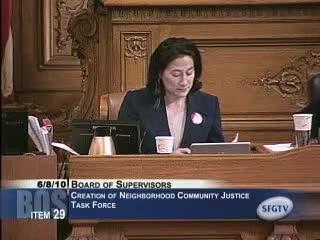
Supervisors split on sit‑and‑lie; board creates neighborhood community justice task force, rejects sit‑and‑lie ordinance
Summary
The Board approved an ordinance establishing a Neighborhood Community Justice Task Force to explore restorative/community-justice approaches, while rejecting a separate sit‑and‑lie ordinance that would have prohibited sitting or lying on sidewalks during specified hours.
The Board of Supervisors took separate actions on measures aimed at addressing public-safety and quality-of-life concerns on sidewalks and public spaces. The board approved an ordinance creating a Neighborhood Community Justice Task Force to study restorative justice and community‑based responses to recurring problems in neighborhoods; it rejected a separate sit‑and‑lie ordinance that would have criminalized sitting or lying on sidewalks during specified hours.
President David Chiu, chair of the Public Safety Committee, framed the task force as a short‑term (progress report within three months) body to examine alternatives to enforcement-only approaches and to recommend models such as community courts and restorative justice centers. “What I have proposed is looking at different models of criminal justice in approaching the situation,” he told colleagues.
The sit‑and‑lie ordinance, originally framed as a measure to provide police with a proactive tool to address disruptive sidewalk behavior, drew lengthy debate. Supporters said existing laws did not allow officers to proactively address behaviors that intimidate residents and merchants. Opponents — including several supervisors and civil‑liberties advocates — said the police already had legal tools, that the ordinance risked selective enforcement and unintended consequences for day laborers, and that the policy problem had not been sufficiently described by the Mayor’s Office of Criminal Justice or the Police Department at prior hearings.
Supervisor Maxwell, a co‑sponsor of the sit‑and‑lie ordinance, said the measure was intended to be a narrow tool and urged colleagues to support it; Supervisor Campos and others said the problem had not been proved and that enforcement of existing laws and reform of court and diversion systems should be prioritized.
The board approved item 29 (Neighborhood Community Justice Task Force, as amended) by unanimous consent on the same‑house/same‑call basis. On item 30, roll-call voting produced three ayes and eight noes; the sit‑and‑lie ordinance failed.
Board members who opposed the sit‑and‑lie measure called instead for investments in community-based services, improved enforcement of existing laws, targeted foot and beat patrols, and reforms to the infraction and traffic court system. Supporters said the ordinance would allow police to intervene before conduct escalated and pointed to examples in other cities where sit/lie laws were sparsely enforced.
The task force will convene to recommend alternatives and report back to the Board; the failed sit‑and‑lie measure will not proceed.