Get Full Government Meeting Transcripts, Videos, & Alerts Forever!
Get email alerts on the Transit Muni topic
No spam. Unsubscribe anytime.
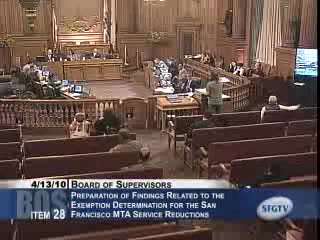
Board affirms MTAexemption; planned 10% Muni service cuts may proceed
Summary
After a full-day hearing and public comment, the Board of Supervisors voted 6-5 to uphold the Planning Department's determination that the Municipal Transportation Agency's proposed service reductions are statutorily exempt from CEQA, allowing the MTA to move forward with planned cuts tied to a fiscal emergency.
The San Francisco Board of Supervisors on April 13 affirmed the Planning Department's determination that the Municipal Transportation Agency's (MTA) planned reductions in transit service are statutorily exempt from environmental review, clearing the way for the MTA to implement broad service changes tied to declared fiscal emergencies.
The vote came after a contested hearing in which an appellant and dozens of public speakers argued the exemption could not be used for the proposed May 2010 service reductions. The board's final roll call on a motion to affirm the exemption was 6 in favor, 5 opposed.
Supporters of the appeal argued the MTA had not followed the statutory steps required by California Public Resources Code section 21080.32 and that certain May 2010 cuts were not part of the public hearing record when the original fiscal emergency was declared. Appellant David Pilpel told the board: "The Municipal Transportation Agency ... is planning to reduce municipal railway, muni, transit service by 10% without conducting any environmental review." He urged the board to send the matter back for further process or require environmental review.
Planning department staff and MTA officials countered that the statutory exemption is narrow and procedural, and that the MTA met the statutory criteria. Victoria Wise of the Planning Department said the exemption "does not require the planning department to look at the impacts that a project will have on the environment" and emphasized the four statutory criteria the department used to determine eligibility. MTA representative Sonali Bose said "no one at the MTA, including the MTA board and staff, wants to see transit service reductions," argued the agency faced an immediate funding shortfall, and described the revenue losses that drove the declaration of fiscal emergency.
Public comment was heavily weighted toward riders and transit advocates. Riders and small-business representatives described how frequent service and route reliability are central to daily life and commerce; transit operator Doreen Maxwell and others warned of safety and operational impacts from deeper cuts. Several speakers asked the board to require the MTA to produce additional financial detail before implementing service changes. Supporters of the MTA urged the board not to delay implementation, arguing the agency must act quickly to avoid an even larger fiscal shortfall.
After discussion, Supervisor Carmen Chu moved to affirm the Planning Department's statutory-exemption determination; Supervisor Dufty seconded. The board then conducted a roll-call vote: supervisors Dufty, Elsber[n/Ellsberg], Maxwell, Alioto-Pier and Chu voted yes; supervisors Marr, Mercuri[n/Mercurini], Avalos, Campos and Daly voted no. The board's action affirms the Planning Department's certificate of determination and allows the MTA to proceed unless further legal action is taken.
The decision does not itself enact specific service cuts; it resolves only the question of whether those cuts are subject to CEQA environmental review under the transit-statutory exemption. MTA staff said planning for service implementation and scheduling would continue; the agency also remains subject to other legal and administrative checks.
The appeal hearing generated significant public testimony and pointed questions from supervisors about the sufficiency of the MTA's financial documentation, the definition and duration of a "fiscal emergency," and the scope of items that may be treated under the statutory exemption. Several supervisors said they were not comfortable with an interpretation that would permit an agency to use a single fiscal-emergency declaration as blanket authority for unrelated or later actions without clear public notice and a demonstrable nexus to the original emergency.
The board's vote resolves the immediate procedural question but leaves open other policy and oversight avenues. Several supervisors signaled interest in further budget hearings and in requiring greater transparency and updated financial analysis from the MTA.
Ending
The MTA said it will proceed with implementation planning for its reductions subject to its board schedule; opponents said they are reviewing legal options. Meanwhile the supervisors who pressed for additional process said they will continue to press MTA officials for more detailed budget information at upcoming committee hearings.