Get Full Government Meeting Transcripts, Videos, & Alerts Forever!
Get email alerts on the Land Use topic
No spam. Unsubscribe anytime.
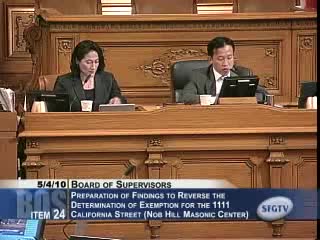
Board affirms CEQA exemption, approves conditional use for Masonic Auditorium with added limits
Summary
After public appeals and hours of testimony, the Board of Supervisors upheld the Planning Department's finding that upgrades at the Masonic Auditorium (1111 California St.) are exempt from environmental review and approved a conditional-use authorization with additional limits on capacity, event counts and operations.
The San Francisco Board of Supervisors on Tuesday affirmed the Planning Department's determination that planned interior renovations and a modest increase in capacity at the Masonic Auditorium at 1111 California St. are exempt from further environmental review, and it approved a conditional-use authorization for the venue subject to added conditions meant to limit neighborhood impacts.
Supporters including the building owner, the Masons of California, and Live Nation — the contracted operator — said the renovations and updated sound and lighting systems are intended to modernize a 1958 venue, expand concession services and allow the hall to compete for regional bookings. Opponents — neighborhood residents and community groups — argued the changes would materially intensify activity on Nob Hill and called for a full environmental impact report.
Why it matters: The decision preserves the auditorium as a regional performance venue while imposing operational limits aimed at reducing traffic, noise and late-night disturbance in an area that mixes residential buildings, hotels, Grace Cathedral and small businesses. The vote sets conditions that the Board and Planning Commission will monitor and that the police and sponsor must coordinate on enforcement.
Key facts and vote: Planning staff concluded the proposed changes amounted to a modest increase in capacity (from about 3,200 to 3,500 maximum attendees) and did not create a significant environmental impact under CEQA (Class 32 infill exemption). The supervisors voted 10–1 to affirm the Planning Department's CEQA determination. The Board then disapproved the Planning Commission's original conditional-use decision but approved a conditional-use authorization for the project with additional conditions; that action passed in a 10–1 vote as recorded by the clerk.
What the board added: Supervisors imposed a package of additional operational limits and requirements addressing capacity, event counts, hours, traffic and loading, security staffing, queuing, reporting and alcohol service. Highlights of the added conditions include a lower-capacity cap than the sponsor’s maximum, a reduced annual limit on large evening events, tighter controls on loading and bus parking, requirements that more queuing occur inside the building (not on public sidewalks), minimum police/security staffing tied to event size, and an expanded periodic public reporting requirement to the Planning Commission.
What supporters said: Alan Casalew, secretary for the Masons of California, told the board the auditorium has been a public event venue since 1958 and needs modernization to remain competitive. Live Nation representatives emphasized their track record running venues and noted they already operate the building under safety protocols. Lee Smith, chairman of Live Nation San Francisco, and other industry witnesses said upgraded, permanent sound and lighting would reduce ad-hoc truck activity and speed load-ins.
What opponents said: Residents and neighborhood groups cited examples of event night gridlock, constrained pedestrian routes on steep streets, queuing and trash problems after shows, and concerns about emergency-vehicle access during heavy traffic. Appellants asked the board to order a full environmental impact report; attorneys for appellants argued cumulative effects and nighttime general-admission concerts were not adequately studied.
Planning analysis and police position: Planning staff presented a transportation analysis, a noise study and other material and concluded the modest capacity increase and operating limits would not create significant new environmental impacts. The Police Department had raised concerns during the Planning Commission hearing; planning staff and the applicant agreed conditions requiring coordinated police/security protocols and the ability for police to require additional measures in specific cases.
Implementation and next steps: The Board’s action imposes a schedule of monitoring and reporting (including semiannual or annual reports) and directs enforcement of the new conditions by appropriate city authorities. The conditional-use authorization runs with the property and will be enforceable; the Planning Commission and city staff retain authority to review compliance and require adjustments.
The board’s decision balances the venue’s regional cultural role against neighborhood impacts by approving renovations and new operating rules while adding extra conditions to address traffic, queuing, loading, security and reporting.
Ending: The board’s approval preserves the Masonic as a public performance venue while imposing a set of operational constraints and monitoring requirements. Neighbors and the sponsor now return to implementation and enforcement, and the city will track compliance through periodic reports to the Planning Commission.