Get Full Government Meeting Transcripts, Videos, & Alerts Forever!
Get email alerts on the Labor And Contracting topic
No spam. Unsubscribe anytime.
Board rejects Prop J bids to privatize janitorial and hospital security services after heated budget and labor debate
Summary
The San Francisco Board of Supervisors on July 16 rejected two resolutions that would have allowed janitorial and hospital-security work to be contracted out under Proposition J, after a day-long debate tying the proposals to sheriff overtime, union concessions and a looming budget shortfall.
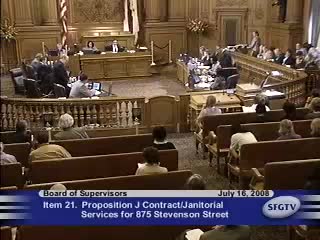
The San Francisco Board of Supervisors on July 16 rejected two resolutions asking the board to concur with the controller's certification that certain city services could be contracted out under Proposition J, voting down item 21 (janitorial services at 875 Stevenson) and item 22 (security services at San Francisco General Hospital, Laguna Honda Hospital and city clinics).
The votes came after a contentious debate tying the contracting proposals to larger budget pressures, sheriff staffing needs and union concessions. Supervisor McGoldrick, whose office introduced the items, said the janitorial proposal affected five positions and represented a net savings for the city: “This is the only private building that we rent out where we do not actually contract our custodial services. This is a net savings of $110,000,” he said, citing the mayor’s budget office analysis.
Supervisor Daley and several colleagues argued the savings came largely from lower wages and benefits for contractor staff and would shift costs back to city systems and hospitals if employees lost health benefits. “When we pay less in terms of benefits, oftentimes it ends up coming to get us on the backside,” Daley said, warning of higher charity-care and public-health costs.
Item 21 (janitorial services at 875 Stevenson) failed on a roll-call vote of 5 ayes and 6 noes. Item 22 (hospital and clinic security) also failed, 4 ayes and 7 noes, after an earlier motion by Supervisor McGoldrick to continue the security item for six days failed on a 5–6 roll call.
Much of the day’s debate centered on the sheriff’s staffing and overtime costs. McGoldrick and others said a letter from Sheriff Mike Hennessy warned the board that returning deputy sheriffs to hospital security duties could reduce expensive overtime tied to reopening parts of the jail; McGoldrick said the sheriff estimated a $5 million fiscal impact this year and $8 million next year tied to overtime. Supporters of keeping the security work with deputy sheriffs and against contracting argued institutional police do not have the training to handle some custody-related tasks and that deputy sheriffs provide critical safety at medical facilities.
Labor voices and supervisors who opposed the contracting said the proposed savings reflect lower wages and reduced benefits under private contracts, not operational efficiencies. Several supervisors urged compromise talks with SEIU, the Municipal Executives Association and institutional police officers; Supervisor Ellsburn and others urged more negotiation time, but the motions for continuance failed. Supervisor Mercarimi framed the vote as part of a broader concern about privatization creeping into city services.
With the votes, the board declined to concur with the controller’s determinations and the resolutions failed. Supporters of the measures said they were needed to close structural budget gaps; opponents said the city should preserve public jobs and press unions for concessions by other means.
What happens next: because the board did not concur, the city will not move forward under the specific Proposition J certifications called for in each resolution. Supporters said they would continue discussions with the mayor’s office, the sheriff and labor groups about staffing and budget tradeoffs.
Votes at the meeting show the depth of division: item 21 failed 5–6, and item 22 failed 4–7; a motion to continue item 22 to allow more negotiation was also defeated 5–6.
Ending: The debate highlighted a recurring budget-year dilemma for San Francisco — balancing short-term savings proposals with potential long-term costs to public services and workers, and whether the board and labor can find compromise solutions short of contracting out.