Get Full Government Meeting Transcripts, Videos, & Alerts Forever!
Get email alerts on the Budget And Health topic
No spam. Unsubscribe anytime.
Supervisors hold hourlong hearing on proposed public‑health cuts; interim budget, salary ordinances pass
Summary
The San Francisco Board of Supervisors on June 16 held a special hearing to review proposed cuts to the Department of Public Health, hearing hours of testimony from providers and clients before approving interim budget and salary ordinances on first reading.
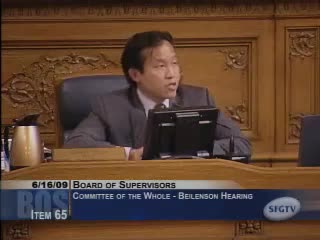
The San Francisco Board of Supervisors on June 16 held a special “Builenson” hearing to review proposed reductions in the Department of Public Health budget and to receive public comment on cuts to mental‑health, substance‑abuse and community outreach programs. The board voted to adopt interim budget and interim salary ordinances on first reading.
The hearing drew a line‑up of community providers and clients who warned that proposed cuts would force higher use of emergency services, increase homelessness and worsen public safety. Department of Public Health Director Dr. Mitch Katz gave the department’s budget overview, including revenue and the administration’s reductions.
Katz told the board the department had identified $107,000,000 in additional revenue for the current year, and said “of the remaining $67,000,000 that is reduced … $12,300,000 … is service reduction.” He said the largest single program reduction proposed was $6,200,000 in substance‑abuse services and that mental‑health services reductions totaled about $3,300,000, while roughly $55,000,000 of the added revenue consisted of one‑time federal FMAP funds.
Why it matters: Supervisors and dozens of community organizations said the cuts would disproportionately affect people with serious mental illness, older adults, and tenants in single‑room occupancy hotels. Multiple speakers — program directors, clinic staff and people who use the services — described programs that provide low‑threshold access to care and crisis diversion that they said could not be replaced by emergency response.
Supervisor John Avalos, who pressed for the hearing to be scheduled after the Budget Committee’s review, said his own office had tallied the budget shortfall and emphasized that the people who rely on safety‑net services “are making… a sacrifice” during the fiscal crunch. Supervisor Chris Daly noted a separate legal requirement and the board’s duty to hold a public hearing: “state law requires us… to hold this hearing when we reduce health services,” he said, and called for full public disclosure of impacts before any final cuts are adopted.
Public testimony: More than 80 individuals and dozens of community groups spoke during the hearing. Examples: - Denise Deanna of Senior Action Network urged the board to “spread the pain in a balanced fashion.” - Nathan Slowinski of the Tenderloin Self Help Center said his program’s drop‑in services are “the only organization in the city that goes door to door and interacts with SRO tenants” and warned that eliminating it would put more people at risk of homelessness. - Gail Gilman of Community Housing Partnership urged equity across general‑fund departments and urged supervisors to seek efficiencies in city management before cutting frontline services. - Representatives of Conard House, Caduceus Outreach Services, Westside Crisis and MAP (the Mobile Assistance Patrol) described cuts that would reduce outreach vans, drop‑in counseling and same‑day psychiatric access.
Board action: After public comment and discussion, the board approved two interim procedural measures on first reading: the interim consolidated budget and annual appropriation ordinance (Item 25) and the interim annual salary ordinance (Item 26). Both measures passed on recorded votes with 7 ayes and 3 noes.
What the votes do and next steps: The interim ordinances allow the city to operate while the detailed permanent budget negotiations continue; they do not finalize all program decisions. Several supervisors described the interim votes as a step toward a negotiated solution and said they would continue to press to restore behavioral‑health and community services during the next budget hearings. Katz said some proposed service reductions would not be implemented immediately (he cited a request‑for‑proposal timing that, if enacted, would not start until January) and that the department would work with the board to minimize harm where possible.
Bottom line: The hearing highlighted the tension between immediate budget constraints and long‑term public‑health and public‑safety goals. Supervisors signaled they want a broader conversation about how to share the budget shortfall across departments; community speakers urged restoring low‑threshold mental‑health, substance‑abuse and outreach services that they said are cost‑effective and prevent higher‑cost emergency responses.