Get Full Government Meeting Transcripts, Videos, & Alerts Forever!
Get email alerts on the Housing Renters Protections topic
No spam. Unsubscribe anytime.
Board approves package of tenant protections; mayor signaled possible veto
Summary
The San Francisco Board of Supervisors voted to adopt four ordinances aimed at expanding tenant protections and limiting rent increases; members warned the mayor had signaled intent to veto portions or all of the package.
The San Francisco Board of Supervisors on Tuesday approved a package of ordinances intended to expand protections for renters, including limits on annual rent increases, new hardship relief for tenants whose rent would exceed a third of their gross income, and restrictions on evictions tied to additional occupants.
Supervisor Daley, speaking in favor of the measures, said the package “is carefully crafted” and argued it would help families facing displacement and the economic pressures of the recession. Daley warned the mayor had signaled an intent to veto parts or all of the package and asked colleagues what alternatives the mayor would offer to renters if a veto occurred.
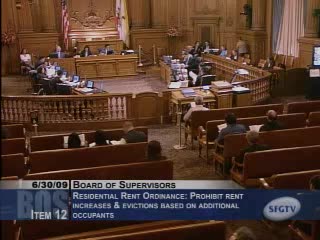
The package included four separate ordinances on the board agenda: an amendment to the housing code to promote affordable housing and protect both prospective and current tenants (item 9); an amendment to the administrative code capping annual and bank rent increases at 8 percent and requiring written notice for base increases (item 10); an amendment to allow tenant financial-hardship relief when rent would exceed 33 percent of gross income and requiring multilingual outreach (item 11); and an amendment to prohibit rent increases and evictions for additional occupants when totals remain within municipal occupancy limits (item 12).
Why it matters: Supervisors said the ordinances respond to rising displacement and eviction risks as households face job and income losses. Supporters argued the measures would reduce pressure on shelter and social services and prevent increases in overcrowding and substandard housing.
Roll-call outcomes and vote details: The board recorded roll-call votes for each ordinance. Item 9 passed 6–4 (Ayes: Supervisor Mercurimi; Supervisor Avalos; Supervisor Campos; President Chu; Supervisor Daley; Supervisor Mar. Noes: Supervisor Elliot O'Pier; Supervisor Chiu; Supervisor Dufty; Supervisor Ellsburn). Item 10 passed 7–3 (named votes recorded include Ayes: Supervisor Mercurimi; Supervisor Avalos; Supervisor Campos; Supervisor Daley; Supervisor Duffy; Supervisor Mar; Noes: Supervisor Elliot O'Pier; Supervisor Chu; Supervisor Ellsburn; overall tally recorded as 7 ayes, 3 noes). Item 11 passed 6–4 (tally recorded 6 ayes, 4 noes). Item 12 passed 6–4 (tally recorded 6 ayes, 4 noes). The ordinances were recorded as “finally passed” on the council floor. The record shows several supervisors voting yes on some items and no on others; the clerk read each roll-call in full during the meeting transcript.
Discussion vs. decision: Most substantive debate recorded on these items consisted of Supervisor Daley urging passage and warning of a possible mayoral veto; the meeting record does not show the mayor speaking on the floor. Several supervisors cast recorded no votes on one or more of the ordinances. The ordinances themselves amend city administrative and housing codes and were adopted by roll call on the day’s agenda.
Next steps: The ordinances are adopted by the board; the transcript records supervisors’ expectation of a possible mayoral veto on parts or all of the package. The board did not record any deferral, amendment, or direction to staff tied to implementation in the floor discussion captured in the transcript.
Ending: The board approved the package by individual roll calls; the mayor’s response and any veto messages are not recorded in the transcript and would determine next steps for implementation or further action by the board.