Get Full Government Meeting Transcripts, Videos, & Alerts Forever!
Get email alerts on the Airport Operations topic
No spam. Unsubscribe anytime.
Supervisors concur with airport emergency after boiler failures; airport staff says replacement was planned but misjudged timing
Summary
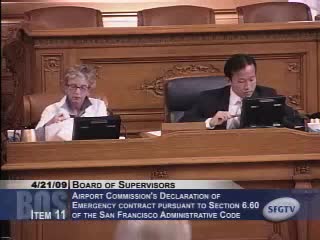
The Board of Supervisors unanimously concurred with an Airport Commission declaration of emergency after two boilers failed at the airport. Airport staff told the board the replacements were planned as part of the capital program but failed sooner than expected, limiting competitive procurement options.
The City and County of San Francisco Board of Supervisors on April 2009 adopted a resolution concurring with an Airport Commission declaration of emergency after failures of multiple boilers at the San Francisco airport, clearing a procedural step the airport said it needed to proceed with emergency replacement work.
Supervisor Campos pressed airport staff on why the city waited until equipment failed to act. "Is there a plan to address this issue differently, to be proactive so that we don't find ourselves in a situation where something like this doesn't happen again?" he asked.
Peter Nardoza, government affairs officer at the San Francisco Airport, told the board: "We misjudged. To be very honest with you, we made a mistake. We had planned to replace these boilers two years from now." He said the boilers were included in the airport’s five-year capital plan and were in the design phase when they failed. "We were wrong, sir. We made a mistake. They failed," Nardoza said.
Nardoza explained the airport had sought to level capital costs after discussions with major airline tenants, who had requested smoothing of capital expenses during financially difficult times. That approach, he said, led staff to anticipate the boilers could last until the 2010–11 fiscal year. When the boilers failed, Nardoza said airport staff contacted four vendors for verbal bids and accepted the lowest one they received; he identified Giladi Brothers as the bidder accepted and said the price was within the scope of the budget the airport had planned for replacement.
Supervisor Campos told staff that emergency procurement narrowed the window for a fully competitive bid and asked whether the airport would change its preventive maintenance or replacement timing to avoid similar emergent situations. Nardoza acknowledged the constraint and said the airport would "be as diligent as we may as we can in watching these kinds of situations in the future."
The board then took a roll call vote and the resolution concurring with the Airport Commission's emergency declaration was adopted.
Why it matters: The concurrence allows the airport to proceed with emergency work and related contracts. Supervisors pressed staff on preventive maintenance and procurement approach because unplanned equipment failures can limit competitive procurement and increase costs.
Details and clarifying points
- Equipment and condition: Airport staff said the boilers in question were approximately 31 years old and 16 years old (as cited in the discussion). The failures involved boiler 4 and boiler 1.
- Procurement: Staff stated they had verbally solicited four vendors and accepted the lowest bid from Giladi Brothers; the airport had a replacement budget anticipatated in its five-year capital plan and had been in design for replacement when the boilers failed.
- Financial and operational context: Nardoza said major tenants (airlines) had requested smoothing capital improvement costs over time, which influenced timing for larger replacements.
What the board decided: By concurring with the Airport Commission’s declaration of emergency, the board authorized the procedural step enabling the airport to contract for immediate repairs or replacements under emergency procurement rules.